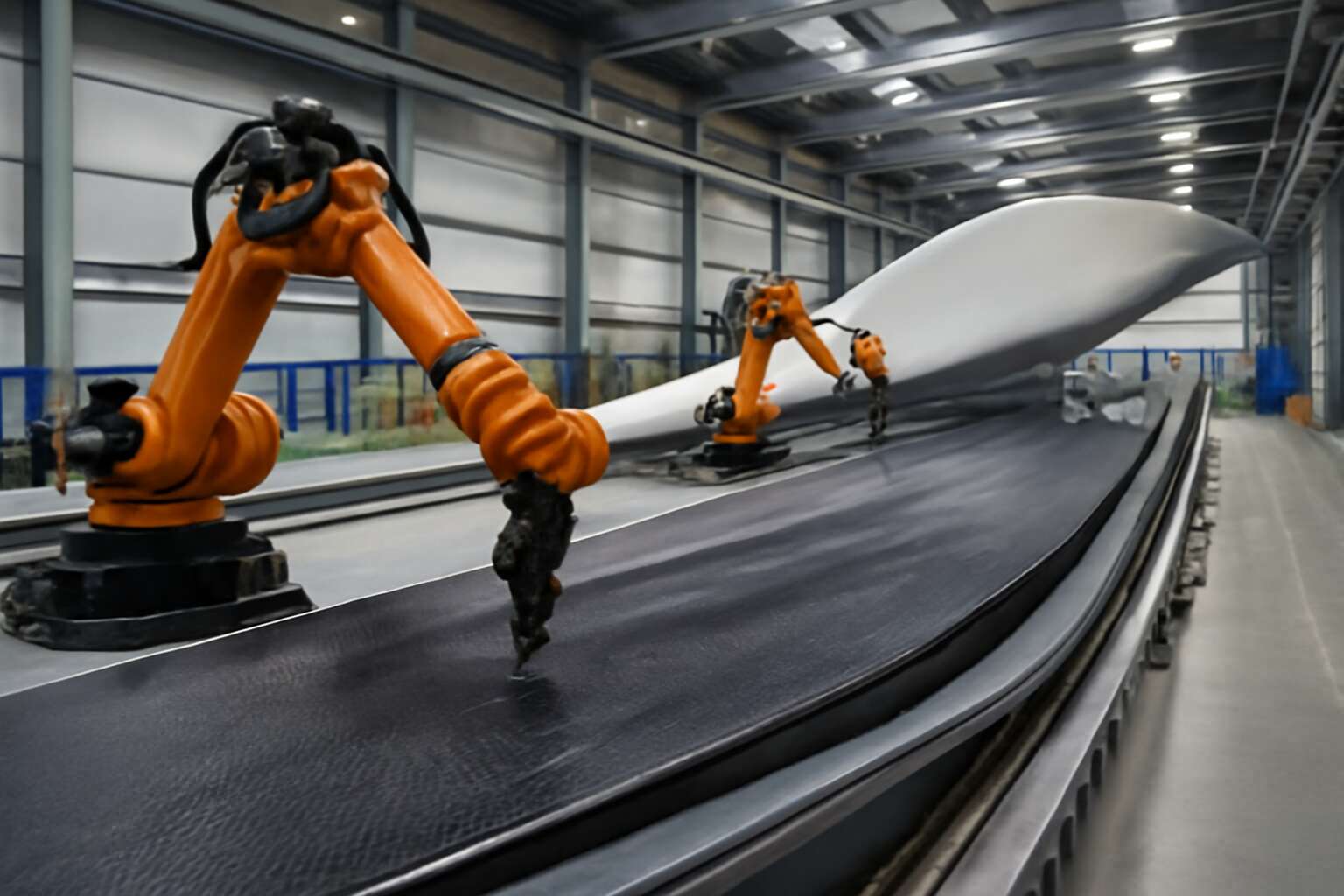
Wind turbine blade manufacturing overview
Blade design and aerodynamic considerations
That moment when a blade slices into a gust and converts wind into watts is pure engineering theater. In South Africa’s wind corridors, the challenge is bigger than the turbine itself: parts must be light, tough, and reliably. If you’re curious about how wind turbine blades are made, the answer begins with composite magic.
Blade manufacturing is a dance of materials and mastery. Here’s a distilled flow you’ll often see on SA shop floors:
- Design and material selection
- Layup, resin infusion, and curing
- Surface finishing and lamination checks
- Quality control and non-destructive testing
Design and aerodynamic considerations follow, shaping the airfoil and twist along the span to harvest wind efficiently. Engineers tune thickness, taper, and trailing-edge contour to keep lift high and loads tame, especially at variable speeds. The result is a blade that behaves well from sea spray to dust storms and reduces fatigue while punching above its weight.
Materials selection and resin systems
Blades can weigh more than five tonnes, yet they must glide like sails in a storm. To understand how wind turbine blades are made, we start with materials that combine lightness, strength, and weatherproof charm—precisely the trifecta SA wind corridors demand.
Materials selection centers on reinforced polymers that endure gusts and grit. The roster typically includes:
- glass fiber composites
- carbon fiber reinforcements
- epoxy or vinyl ester resin systems
- UV-stable surface coatings
Resin systems are chosen for cure profiles, temperature resistance, and moisture tolerance, while resin infusion and multi-stage curing tame exotherm and shrinkage. The result is a blade that remains stiff yet forgiving, with a surface finish that laughs at sun, rain, and the occasional SA veld ember.
Production workflow from design to delivery
Across South Africa’s wind corridors, the blade’s journey begins long before the first gust. In the hush of the factory, engineers translate wind’s whisper into precise geometry, shaping a component that stretches up to sixty metres and carries daylight into millions of homes!
This is how wind turbine blades are made, tracing a workflow from concept to on-site performance. The path runs mold to coat, aligning layup, infusion, cure cycles, and meticulous inspection to keep the surface faithful, stiff yet forgiving against the veld sun and rain.
Key stages unfold in steady rhythm as the blade moves from drawing board to hub-ready form.
- Mold fabrication and layup
- Resin infusion and curing
- Surface finishing and quality checks
- Final assembly and delivery
Deliveries are coordinated with climate-aware logistics, QA gates, and trackable traceability, ensuring the finished blade meets the site’s cadence and Cape climate demands.
Blade sizes, class types, and installation considerations
Blades now span 60 meters and more, turning Cape winds into dependable power. This is how wind turbine blades are made, a strenuous ballet of composites, heat, and meticulous checks that translate gusts into electricity!
Blade sizes split into classes by application: onshore designs commonly sit in the 50–65 m class, offshore designs push toward the 70–90 m range, and hybrid builds adapt to site constraints. The production approach is tuned to these categories to balance stiffness, weight, and transport realities.
The installation reality by class includes:
- Onshore blades: 50–65 m spans, road-transportable with route planning.
- Offshore blades: 70–90 m, designed for heavy-lift installation and corrosion resistance.
- Urban or constrained sites: shorter spans and modular handling for rapid commissioning.
In South Africa’s wind corridors, logistics, climatology, and QA gates choreograph the final disposition from factory to hub.
Climatic realities—sun, dust, and sudden gusts—shape surface finish decisions and on-site inspection tempo.
Materials and composite technology
Fiberglass vs carbon fiber composites for wind blades
Blade integrity under gusts powers the grid. In the wind-energy landscape, understanding how wind turbine blades are made hinges on a quiet truth: composites decide whether a blade flexes or lasts. Fiberglass and carbon fiber bring different personas to the layup—each with a story of stiffness, fatigue, and resilience.
Here are the core contrasts that guide material choice:
- Fiberglass: cost-effective, versatile, forgiving in layup, good impact resistance.
- Carbon fiber: exceptional stiffness-to-weight, higher fatigue life in critical regions, but at a premium.
- Hybrid strategies: carbon in high-load skins, fiberglass in webs to balance performance and cost.
Local SA contexts, supply chains, and repair ecosystems also shape the balance. The discipline blends engineering rigor with material awareness—choices echo far beyond the workshop floor.
Core materials and sandwich construction
Across South Africa’s wind corridors, the quiet math of materials shapes every blade that greets the sky. In the workshop, core materials and sandwich construction give blades their grace—stiff skins embrace a buoyant core, so gusts become measured notes rather than ruptures!
A few core choices shape the outcome.
- balsa cores or synthetic foams for light, energy-absorbing centers
- Nomex honeycomb for crush resistance in high-load zones
- PVC foam skins to support stiffness without excess weight
Ultimately, how wind turbine blades are made is a story of discipline, regional craft, and the artistry of composites that endure the South African wind!
Resin systems and curing methods
South Africa’s wind corridors are expanding fast, turning gusts into gigawatts and spreadsheets into poetry. If you’re wondering how wind turbine blades are made, the answer starts in resin and cure—where chemistry meets craft, and every molecule signs off on longevity.
Resin systems and curing methods shape performance more than expected. Epoxy resins deliver high stiffness and fatigue resistance, vinyl ester offers moisture barriers, and polyester provides cost-effective skins.
- Epoxy resins: high stiffness and fatigue resistance
- Vinyl ester: moisture resistance and barrier properties
- Polyester: cost-effective skins
Curing methods vary from vacuum infusion and heat-assisted cures to room-temperature cures with post-curing—each choice tunes resin flow and temperature history to final blade performance, even under SA’s variable winds.
In the end, resin systems and curing methods are the quiet artisans behind every blade, bending science to the service of the sky.
Sustainability and recyclability in blade materials
South Africa’s wind corridors are turning gusts into gigawatts, and the blade’s journey starts with materials that bend, not break. “Material choices aren’t cosmetics, they’re performance insurance,” a veteran composites engineer likes to say. This is how wind turbine blades are made—where resin meets design and weather meets practicality in a race against the elements.
Materials and composite technology now chase sustainability as a core spec. Lightweight fibers pair with resin systems designed for repairability and end-of-life recycling. In South Africa, manufacturers pilot bio-based resins, recycled fibers, and closed-loop processes that trim waste while keeping performance on par with traditional methods.
- Recycled carbon fiber reinforcements where feasible
- Bio-based resins that cut embodied energy
- Disassembly-friendly layouts for easier recycling at end-of-life
By marrying resilience with recyclability, blade materials become a strategic asset—quietly powering South Africa’s green transition without fanfare.
Advanced coating and surface protection
A 30% longer service life is the promise behind advanced coatings for wind blades. A key truth in how wind turbine blades are made is that coatings do more than color the surface. From ceramic-inspired topcoats to sealants that breathe with temperature swings, surface protection becomes a quiet shield, preserving aero performance across decades.
- Ceramic-augmented polyurethane topcoats for abrasion resistance
- Self-healing binders that seal microcracks
- Hydrophobic nano-coatings that shed rain and prevent dirt buildup
In South Africa, coastal and arid corridors demand coatings that endure glare and salt spray, and local labs tune formulations for recyclability.
Production processes and fabrication methods
Layup molding versus prepregs in blade fabrication
In production, blade segments are built through disciplined processes that mix layup molding with prepregs. Layup molding relies on dry fibers laid into a female mold, then resin is infused under vacuum and cured. Prepregs arrive pre-impregnated and require tight temperature and humidity control, delivering consistent resin content and predictable performance. This is how wind turbine blades are made in modern facilities!
Two primary routes dominate blade fabrication:
- Layup molding uses dry fibers in a mold, resin infused under vacuum, then cured—great for cost efficiency and scale, with longer cycles.
- Prepregs bring pre-impregnated fibers to a controlled cure, delivering consistent resin content and tight quality, but with higher material cost and climate needs.
Size, fiber type, and curing windows influence the choice, especially in markets like South Africa where supply chains vary and facilities balance pace with energy use.
Vacuum-assisted resin infusion (VARI) and infusion processing
How wind turbine blades are made? VARI and infusion processing perform the quiet magic behind the scenes. In vacuum-assisted resin infusion, dry fiber stacks sit in a female mold while resin is drawn through the layup under a steady vacuum. Precision beats hype here.
Infusion processing adds predictability: resin flow is guided by channel design, pressures are tuned, and cure schedules are scripted for consistency. In South Africa, these methods help plants balance throughput with energy use and climate realities, delivering strong blades without wasting resin or time.
Key flow details include:
- VARI steps: dry fiber stacks, vacuum bagging, resin infusion, cure
- Infusion processing: controlled resin content, resin flow channels, final cure, QA
- QA and testing: non-destructive evaluation after curing
Autoclave and oven curing for composites
In the workshop where blades take shape, curing is when raw fabric becomes a rigid arc. Autoclave and oven curing steer final properties with timing and pressure. This is how wind turbine blades are made: a laminate stack heats under pressure, squeezing out resin pockets to forge a fatigue-ready skin.
Autoclave curing relies on high-pressure steam and uniform heat, delivering near-voidless joints and precise ply alignment. It suits high-spec blades where reliability tops every metric. Oven curing offers a more approachable path: programmable ovens, radiant heat, and a simpler footprint, cutting costs and complexity, making it attractive for mid-volume production in regions with variable energy supply.
Trade-offs to watch include resin content stability, cycle time, and equipment footprints.
- Autoclave: premium quality, tighter tolerances, higher capital.
- Oven: lower capex, greater scalability, easier maintenance.
This balance helps South African plants tailor blade fabrication to local demand and energy realities.
Tooling, molds, and quality control during fabrication
In the workshop where blades take shape, production tooling is the silent backbone. Molds and fixtures hold fibers in perfect alignment, guiding the layup as composite skin forms. This is how wind turbine blades are made.
Key steps and considerations in tooling, molds, and quality control include:
- Tooling and mandrels ensure ply alignment and dimensional accuracy.
- Mold materials and sealants provide repeatable surfaces for resin infusion and curing.
- Quality control uses non-destructive testing and dimensional audits to catch misalignments early.
Tolerances, defects, and inspection protocols
How wind turbine blades are made reveals a ritual of balance and grit. In the resin-soft hush of the workshop, tolerances are carved with a craftsman’s care. Fibers settle, resin flows, and heat and time coax a rising form toward its destiny.
Defects are hunted in quiet checks of geometry and continuity.
- Dimensional surveys at key stations ensure the curvature stays within spec.
- Non-destructive testing catches subsurface flaws before cure finalizes.
- Process-control sampling confirms resin flow and gel timing align.
In South Africa’s wind corridors—from the Cape to the Karoo—this discipline underpins reliable energy, keeping blades singing with the wind’s truth.
Quality assurance, testing and standards
Non-destructive testing techniques for blades
Quality assurance in blade production is discipline, not drama. In a field where a tiny flaw can trigger costly downtime, understanding how wind turbine blades are made hinges on relentless checks at every stage. We base the process on ISO 9001 QA, meticulous traceability, and robust documentation—because precision is a wind-power advantage.
Non-destructive testing techniques for blades include:
- Ultrasonic testing (UT) for internal delaminations and voids
- Thermography to reveal subsurface anomalies
- Acoustic-emission monitoring during cure and load
- Shearography for surface and near-surface defects
- Radiography or CT for core integrity
Standards anchor the tests—ISO 9001 as backbone, IEC 61400-1 for wind-energy performance, and SABS guidelines for local audits—ensuring the audit trail speaks the language of South African partners.
Mechanical testing and qualification procedures
Quality assurance in blade manufacture is a discipline, not drama. In an industry where a microscopic flaw can trigger costly downtime, every bend, bond, and batch must be accounted for. ISO 9001 anchors the program, with meticulous traceability and robust documentation tracking materials from supplier to surface. Mechanical testing and qualification procedures guarantee that each blade segment meets defined strength and durability criteria before installation—because this is how wind turbine blades are made.
Standards harmonize testing with IEC 61400-1 for wind-energy performance and SABS guidelines for local audits, ensuring the audit trail speaks a language South African partners can trust.
- Uniaxial tensile testing to verify laminate strength
- Flexural and compressive tests to model bending and stacking loads
- Interlaminar shear strength (ILSS) to confirm ply bonding integrity
- Fatigue and fracture mechanics for long-term durability
- Impact resistance and thermal aging to simulate field conditions
Certification standards and industry guidelines (IEC, GL, DNV)
Quality assurance in blade manufacture is a discipline, not drama. ISO 9001 anchors the program with meticulous traceability from supplier to surface. This is how wind turbine blades are made—built on rigorous QA, transparent documentation, and auditable batch records that catch a flaw before it travels to the field. When every bend, bond, and batch is accounted for, downtime and maintenance costs shrink and reliability climbs.
- IEC 61400-1
- DNV GL guidelines
- SABS standards
- ISO 9001
Certification standards and industry guidelines keep testing aligned with IEC 61400-1 for wind-energy performance, GL (Germanischer Lloyd) and DNV guidelines for global audits, and SABS standards for local audits. The audit trail speaks a language South African partners can trust, reinforcing supply chain integrity and long-term performance.
In-process monitoring and data analytics in blade production
Blades marching toward 70 meters demand a different kind of care. In our facility, every resin batch, every bond line, and every measurement is logged in real time. This is how wind turbine blades are made.
- Real-time in-process sensors monitor cure temperature, resin viscosity, and moisture.
- Digital batch records ensure supplier-to-surface traceability.
- Inline non-destructive testing flags delamination or scarf defects before cure completion.
- Data analytics dashboards highlight process drift and predictive maintenance signals.
Quality assurance is anchored by standards: ISO 9001, IEC 61400-1, DNV GL, and SABS in the local context. We translate sensor streams into dashboards, keeping South African partners confident in supply chain integrity and long-term performance.
Sustainability, lifecycle, and future trends
End-of-life strategies and blade recycling
Circular economy is a design mandate, not a slogan. Understanding how wind turbine blades are made informs how we design for reuse and recycling, keeping value alive long after the turbine’s peak years.
From a lifecycle lens, durability and modularity matter. When blades reach end-of-life, partnerships with recyclers and manufacturers decide whether materials return to feedstock or become building blocks for new products, cutting waste and reducing virgin resource use!
End-of-life strategies and blade recycling are evolving fast, helped by policy shifts and industry partnerships across South Africa.
- Recycling into feedstock for new composites
- Repurposing into civil or energy-storage components
- Partnerships funded by regional decommissioning programs
Digital twins, predictive maintenance, and data-driven QA
Across South Africa’s wind farms, the hum of turbines is rewriting what we call progress. A readout shows a 15% uptick in blade life when lifecycle thinking guides design choices. Understanding how wind turbine blades are made guides every decision toward reuse, repair, and responsible recycling.
Digital twins turn factories and fields into a shared living map. They track stress, heat, and wear in real time, fueling predictive maintenance that reduces downtime and strengthens data-driven QA from fabrication to field service.
As we rethink the blade’s journey, trends like digital twins, predictive maintenance, and data-driven QA shape a future where sustainability is embedded at every stage.
- Digital twins guiding end-of-life pathways
- Predictive maintenance aligning with real-time data
- Data-driven QA linking factory data with field outcomes
Emerging materials and design innovations for lighter blades
Across South Africa’s wind corridors, the blade’s life story is becoming a measurable part of the nation’s sustainability ledger. Early adopters report double-digit gains in material efficiency across the lifecycle, proving that smarter design matters as much as raw power. Understanding how wind turbine blades are made guides every decision toward reuse, repair, and responsible recycling.
Emerging materials and design innovations rewrite the physics of lighter blades. Instead of more resin, developers use bio-based resins with recyclable cores and optimized layups, trimming mass without sacrificing strength. The result is field-ready resilience: easier transport, simpler maintenance, longer service.
- Bio-based resins and recyclable cores
- Topology optimization for lighter structure
- Repair-friendly geometries and sensors
In the broader lifecycle, these shifts push toward repairable assemblies and cradle-to-cradle recycling—anchored by local manufacturing and skilled labour.
Automation, robotics, and Industry 4.0 in blade manufacturing
South Africa’s wind corridors are writing a sustainability ledger, blade by blade. “We don’t just make blades—we curate lifecycles,” says a veteran plant manager. That mindset changes how wind turbine blades are made: more emphasis on reuse, repair, and responsible recycling.
Automation, robotics, and Industry 4.0 are turning blade plants into smarter ecosystems.
- Robotic handling and precise layup for consistent weights
- In-process sensors monitor cure, temp, and resin flow
- Modular curing cells for rapid setup
Across South Africa, local manufacturing now leans cradle-to-cradle. Future trends favor repair-friendly geometry, refurbishable modules, and closer links with waste-to-resource networks.



0 Comments