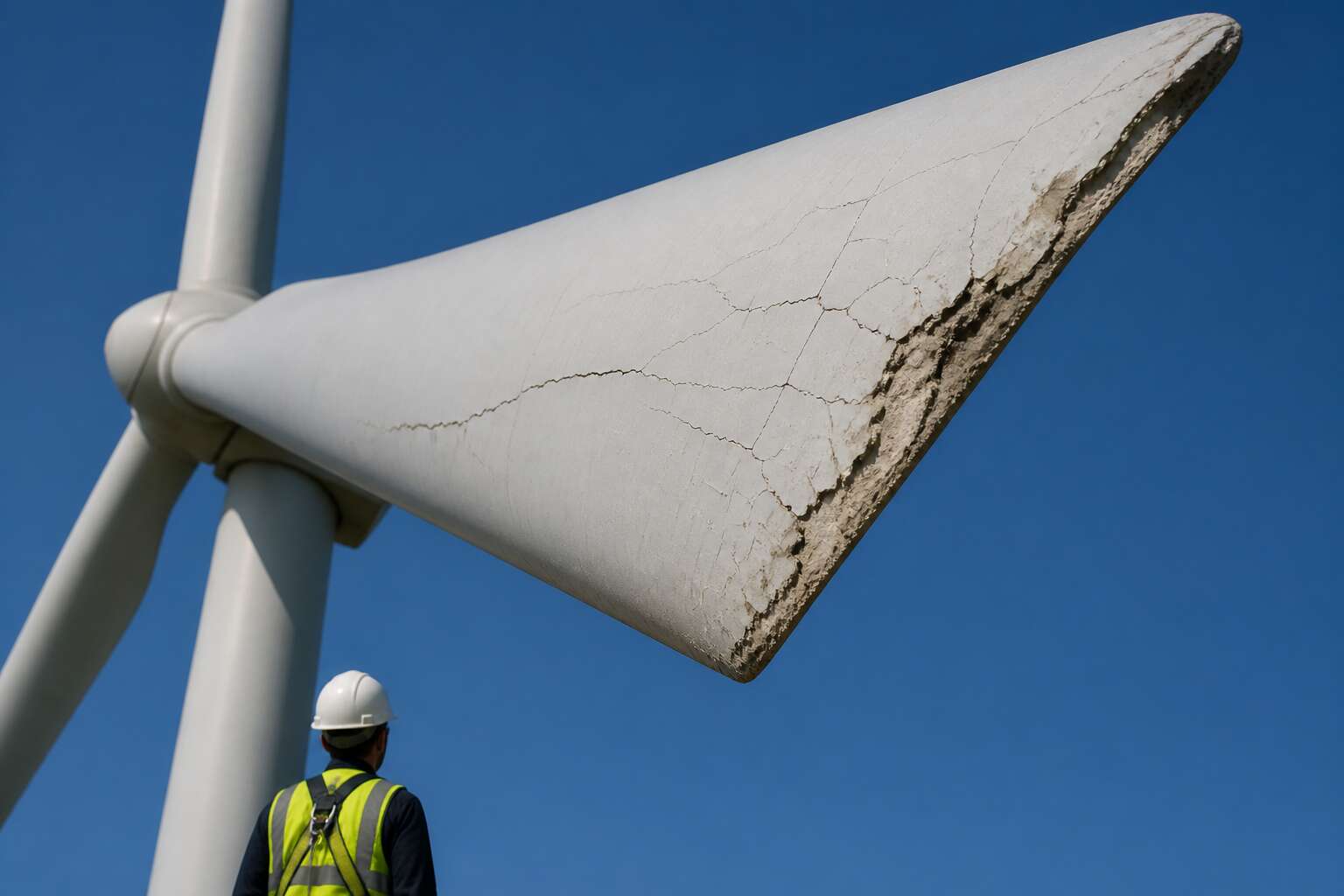
Root Causes of Turbine Component Failures
Structural Fatigue in Rotor Blades
Each rotor blade bends more than 10 million times each year. That constant flexing, driven by gravity and fluctuating wind direction, gradually breaks down the composite structure. Structural fatigue in rotor blades is a slow accumulation of microscopic damage.
Several root causes push blades toward failure. Manufacturing defects such as uneven resin distribution weaken the laminate. Transport mishandling creates hidden stress points. Operational loads accelerate the damage. Fatigue cracks begin where the material is already compromised.
- Trailing edge bonding lines fail first because they carry concentrated strain.
- Lightning strikes leave pinholes that let moisture seep into the core.
- Wind shear causes unequal cyclic loading on each blade.
These failure modes explain why wind turbine quality issues often surface only after years of service, when warranties have expired and inspection costs rise. For South African wind farms, where lightning density ranks among the highest globally, blade fatigue is a familiar challenge.
Gearbox and Bearing Weak Points
A single gearbox failure can idle a turbine for months. Repair costs climb into the millions of rand, and replacement lead times stretch beyond a year. Bearing failures trigger nearly 70% of these breakdowns, a statistic that keeps South African operators focused on early detection.
The root causes are specific and measurable. Bearing surfaces develop micropitting when the lubricant film thins under heavy load. Contaminated oil, common in South Africa’s high-dust environments, embeds abrasive particles into the rollers. Shaft misalignment concentrates stress on the raceways. Each failure mode traces back to inadequate lubrication management.
- Poor oil filtration allows particulate contamination to circulate
- Incorrect bearing clearances create uneven load distribution
- Torque spikes from grid disturbances shock the gear teeth
These weak points explain why wind turbine quality issues vary across sites. The gearbox rarely fails from a single dramatic event. It succumbs to accumulated wear that remains invisible until the damage is irreversible.
Material Flaws and Substandard Parts
Every wind turbine quality issue has a genealogy, and too often it traces back to a compromise in a foundry or a forgery on a certificate. In our audits across South African wind farms, we see the same culprits repeat: non-metallic inclusions, improper tempering, and steel from mills without full traceability.
Substandard parts arrive through price pressure. Components labeled OEM-grade sometimes come from brokers who obscure their origins. A flange that fails chemical analysis can pass a tape measure, and that is the danger.
- Inclusions of slag or oxide in the base metal
- Hardness values outside specified ranges
- Missing documentation for heat treatment cycles
Each flaw is a hidden defect. The turbine runs, the data looks normal, until the load finds the imperfection. That is the cruel arithmetic of these failures!
Hydraulic System Leaks and Actuator Failure
Hydraulic failures often start with contamination. In South African wind farms, a single micron of silt in the fluid can score a servo valve. That valve then hunts, chatters, and finally seizes. The actuator stops responding to the controller. The blade pitch freezes, and the turbine enters an emergency state. We classify this as one of the most underrated wind turbine quality issues because the root cause sits in the fluid, not in the steel.
The common root causes repeat across sites:
- Poor filtration or skipped oil changes
- Seal degradation from high ambient temperatures
- Water ingress from condensation cycles
- Wrong fluid viscosity or mixing of incompatible oils
Each of these produces pressure drops and erratic actuator movement. The load shifts to other components. That sequence is silent until the actuator fails completely. These wind turbine quality issues rarely announce themselves ahead of time.
Environmental Pressures That Expose Quality Gaps
Lightning Strikes and Leading Edge Erosion
Lightning strikes are the great equalizers of the wind industry. A single bolt can turn a meticulously engineered turbine into a smoldering monument to electrical oversight. While the tower often acts as a giant lightning rod, the blades are the primary sacrificial lambs. During a strike, the sheer current seeks the path of least resistance, and if the internal down conductors are poorly installed or use substandard components, the energy will find a way through the blade material itself. This leads to explosive delamination and hidden internal fractures that are nearly impossible to detect from the ground. South African Highveld storms, with their violent electrical activity, are a brutal proving ground for these lightning protection systems.
The specific quality gaps in this area often manifest as:
– Inadequate bonding between the receptor and the down conductor.
– Poorly insulated cable joints that fail under thermal stress.
– Insufficient cross-sectional area of the conductor, which creates internal arcing.
Beyond the drama of a lightning strike lies the relentless, mundane assault of leading edge erosion. Rain droplets, dust, and insects act as microscopic sandpaper, stripping away the blade’s aerodynamic finish over time. When surface quality is already compromised due to poor paint adhesion or pinhole voids in the gel coat, erosion accelerates at an alarming rate. The result is a roughened surface that kills lift and increases drag, leading to a measurable drop in annual energy production. The financial bleed from this degradation is quiet, but it is constant, and it turns a small manufacturing flaw into a multi-year revenue loss. For operators, this erosion is often the first visible symptom of deeper wind turbine quality issues. They see the roughness on the leading edge, but the root cause was a factory process that skimped on environmental protection. Repairing this damage at altitude is costly and forces turbines offline, exposing further weaknesses in maintenance scheduling.
Extreme Temperature and Ice Loading
At minus ten degrees Celsius, a turbine blade can accumulate several hundred kilograms of ice overnight. That load, combined with rapid daytime heating, exposes wind turbine quality issues in the core resin system. I have witnessed this damage firsthand.
When thermal expansion rates differ between the fibre layers and the bonding matrix, micro-cracks appear. Each freeze thaw cycle widens them. The resulting vibration from an imbalanced rotor stresses the main shaft and gearbox mounts.
- Insufficient UV stabilizers in the blade coating, promoting brittle fracture
- Voids in the laminate that trap water, which expands on freezing
- Poor sealing at the blade root, allowing moisture ingress
These failures reduce the turbine’s capacity factor quietly, year after year.
Offshore Corrosion and Moisture Intrusion
Offshore wind farms face a relentless assault from salt-laden air and relentless humidity. The marine environment accelerates galvanic corrosion at every unsealed junction, and this is where wind turbine quality issues often manifest most aggressively. I have seen tower flanges pitted within eighteen months of installation, their protective zinc layers consumed by electrochemical reactions with the sea spray.
The primary weakness lies in the nacelle’s environmental seals. A single failed gasket allows moist air to circulate across electrical cabinets, and the resulting condensation creates conductive paths on control boards.
1. Premature bearing failure from contaminated grease
2. Insulation breakdown in generator windings
3. Crevice corrosion under bolted connections
Moisture also travels through the cable conduits, migrating from the nacelle into the tower base. This hidden ingress corrodes anchor bolts and compromises the foundation’s long-term structural integrity. The turbine continues operating, but the margin of safety erodes with every passing season.
Sand, Salt, and Dust Particle Damage
The Karoo’s dust storms and the Namib’s drifting sand create a different kind of threat. Particles carried at high velocity scour tower coatings, stripping protective layers down to bare metal. I have watched leading edges on inland turbines wear through in half their expected lifespan.
Sand and dust settle on surfaces. Their real damage happens inside. They infiltrate the nacelle through vents and seals, lodging in brake calipers and yaw drives. This grinding action accelerates wear on moving parts, and this is where wind turbine quality issues surface in less obvious ways. Filter maintenance schedules that work in coastal Europe fail completely in South African conditions!
The interior contamination chain follows a predictable sequence:
- Dust bridges across electrical contacts, creating intermittent faults
- Abrasive particles embed in gear tooth surfaces, accelerating micropitting
- Fine sililica clogs cooling fins, raising operating temperatures
Each grain can destroy components in ways design engineers rarely predict.
Design and Manufacturing Oversights
Resonance, Vibration, and Shaft Misalignment
Vibration and resonance rarely announce themselves as immediate failures. They emerge as an irregular tower thrash that changes with every wind shift, or a generator temperature that climbs without a clear cause. On a South African wind farm, this data is often discarded as local turbulence, yet it often stems from design and manufacturing oversights. A gearbox foundation that was never tested for its natural frequency response, or a shaft alignment that skipped the thermal expansion compensation, quickly turn resonance into a driving force.
In practice, the drivetrain behaves like an oscillating system that feeds on its own misalignment. Vibration generates more displacement, which increases the load on bearings and couplings. Three oversights appear again and again in newly commissioned turbines:
Couplings specified for pure torque without considering the alternating bending moments from rotor imbalance.
Main bearing housings that allow insertion tilt under field temperature shifts instead of fixed preload torque.
High-speed shaft machines that are aligned cold, yet never rechecked with an expansion strain on the chassis.
These oversights do not always cause immediate noise. They show up after thousands of load cycles as micropitting on gear teeth or polished wear on a flexible coupling’s spline. Wind turbine quality issues in this form are the most difficult to trace because the defect is not a single part, but the industry’s assumption that a shaft alignment certificate means the structure is silent. Measurement after thermal transition is the only way to confirm that the design truly matches the physical system.
Control System Software and Sensor Errors
Control algorithms are only as truthful as the sensors feeding them. On South African sites, anemometers dusted with Karoo grit report lower wind speeds, so the pitch controller commands more torque than the rotor actually produces. That single miscalibration, repeated over months, loads the gearbox beyond its design envelope. It is not a mechanical fault at all, yet it produces the same damage.
The software side shows its own oversights. Many turbines ship with generic control parameters tuned for European wind classes. Without site-specific adjustment, the controller hunts for a setpoint that does not exist, causing creeping wear in the yaw system.
- Unvalidated firmware updates applied during commissioning
- Damaged thermocouple wires that read ambient temperature as bearing temperature
These are wind turbine quality issues that hide behind apparent normal operation.
Tower and Foundation Integrity Flaws
South African ground moves with the seasons. Expansive clays swell in summer rains and contract through winter drought. A foundation designed for static load will crack when the earth beneath it breathes. Tower anchorage systems carry the same risk. Bolts torqued without verified preload stretch under cyclic loading, and the tower rocks imperceptibly.
Manufacturing errors compound the problem:
- Incomplete weld penetration at flange connections
- Concrete pours with insufficient curing time
- Misaligned bolt holes requiring field modification
These are wind turbine quality issues that surface years after commissioning, when the warranty window has closed and the tower’s harmonic signature has shifted.
Welding Defects and Fastener Quality Control
Engineering drawings arrive with tolerances that South African fabricators struggle to hold. The wind resource is excellent here, but the quality assurance culture in local welding shops is still catching up. Poor fusion at root passes is the most common defect. It hides until fatigue cracks open years later.
Fastener quality control is equally patchy. Imported bolts may arrive with incorrect coating thickness. When torqued to spec, the coefficient of friction varies, so the actual preload is a gamble. Wind turbine quality issues in this category show up as loose flanges and fretted bolt heads.
Quality problems often trace back to:
– Design oversights. Holes indexed from the wrong edge. Fit-up gaps that demand filler beyond the approved weld procedure.
– Production pressure. Schedules that prioritise output over NDT sign-off.
None of this appears in the commissioning report. It appears as resonance shifts and oil samples that don’t match the bearing wear pattern.
Inadequate Prototype Testing and Certification Loopholes
Prototype testing should catch these flaws before serial production. In South Africa, it often does not! A blade that passes static load tests may still fail when the turbine encounters site-specific resonance. Certification bodies review submitted documents, yet rarely inspect the towers erected in the Karoo. We see those consequences years later in blade inspections.
Certification loopholes remain a stubborn contributor to wind turbine quality issues. A turbine certified for a European wind regime is not the same machine assembled from locally sourced components. When the design office never sets foot on the factory floor, the as-built tower does not match the drawing. Design oversights follow a predictable sequence:
- Drawings reference outdated bolt grades.
- Hubs arrive with incorrect bearing seats.
- Prototype towers skip the full-scale test.
Operational Mistakes and Maintenance Shortfalls
Assembly Errors and Torque Mismanagement
Operational mistakes often begin long before a turbine spins. Technicians working under tight deadlines may skip critical verification steps during commissioning. These wind turbine quality issues take shape inside nacelles and hubs that look flawless from the outside.
Torque mismanagement deserves particular scrutiny. Every bolted joint carries a precise specification, yet fasteners are routinely under tightened or over tightened. A single overtightened stud can stretch beyond its elastic limit and fracture months later. Common assembly errors include:
- using uncalibrated torque tools
- applying lubricants that alter friction coefficients
- ignoring cross threading checks during flange assembly
Maintenance shortfalls compound these problems. When visual inspections replace physical bolt checks, early warning signs go unnoticed. The cumulative effect is a turbine that operates normally until a sudden, costly failure interrupts production.
Condition Monitoring System Blind Spots
Even the most sophisticated condition monitoring system cannot see everything. I have watched vibration sensors sit on the wrong bearing housing while technicians trust the output. That data looks clean. The machine is not.
Maintenance shortfalls stretch these blind spots further. When oil sampling intervals are extended or accelerometers are never calibrated, hidden faults get room to grow. These wind turbine quality issues are invisible to any dashboard.
- Ignoring temperature trends in the nacelle
- Overlooking data gaps from faulty transmitters
- Replacing sensors without verifying settings
The system reports normal conditions during a slow, grinding failure. Operational mistakes and maintenance shortfalls work together to hide the truth until production stops with a bang.
Bearing Lubrication Failures
Every bearing has a root cause, so many are signed in advance. Lubrication errors rank among the most preventable wind turbine quality issues, yet they rarely reach a maintenance log. A blocked line or a mismatched grease grade can stall an entire drivetrain.
Operational mistakes set the stage. Technicians grease on a fixed calendar, not on the condition of the bearing. In a dry South African site, a careless burst of grease can push sand past the seal. Maintenance shortfalls then deepen the damage: oil samples wait in a warm vehicle, grease filters are never swapped, and the pump gauges are never checked.
Common problems include:
- No pressure verification after repacking a manual grease gun,
- one grease bucket used across different gearbox types,
- maintenance routes adjusted only after a complete stop.
These actions remain unseen until the bearing cage gives in. That failure is the real wind turbine quality issue behind an otherwise unstoppable shutdown.
Inspection Frequency and Reporting Gaps
Operational mistakes rarely announce themselves. A technician working from a fixed calendar ignores the bearing’s actual condition. On a dusty Karoo site, that missed inspection window becomes a wind turbine quality issue long before the alarm sounds.
Maintenance shortfalls compound quietly. Oil samples sit in a hot bakkie for days, grease filters are skipped, pump gauges stay unread. Inspection frequency follows routine, not risk. Reporting gaps hide the pattern. Common failures include:
- manual log entries completed weeks after the event
- alarm codes cleared without a root cause note
- visual checks signed off without a load test
Each gap strips away the evidence needed to correct course. When the drivetrain finally seizes, the real wind turbine quality issue was the silence in between. The paper trail tells that story, but only if someone thought to write it down.
Grid Connection and Power Electrical Faults
Operational mistakes surface as quiet deviations. A technician setting the wrong torque curve, or a controller left in manual mode after testing, distorts power output for weeks. Maintenance shortfalls behave the same way. Grease intervals stretch, consumables run out, and replacements use whatever is on the truck. None of these show up on a meter, yet each one feeds into wind turbine quality issues.
Grid connection and power electrical faults add another layer. Voltage imbalances and slow breaker responses stress converters and pitch systems. The turbine reacts faster than operator documentation tracks. Common signs include:
- repeated nuisance trips after switching events
- power factor readings drifting from setpoint
- communication errors between turbine controller and substation
Each fault gets logged, but without load data and sequence-of-events records, the root cause stays buried.
Strategies to Improve Turbine Longevity and Reliability
Predictive Maintenance and Sensor-Fused Analytics
Sensor data from a single turbine can exceed half a terabyte per month. The most direct response to wind turbine quality issues lies in fusing these signals into one coherent analysis. Predictive maintenance gains power when vibration, temperature, oil particle counts, and power output are weighed together, not as isolated alarms. Sensor-fused analytics converts raw noise into a clear narrative about component health.
Cape coast wind farms handle salt-laden air and shifting breezes daily, where wind turbine quality issues appear in subtle ways. A single thermal anomaly in a gearbox may mean nothing. Pair it with a subtle blade pitch timing change and a hydraulic pressure drop, and you have a diagnosis. This is the difference between reacting and preventing.
Implementing this requires edge computing, algorithms that learn each turbine’s unique baseline, and sensor cross-checks to filter false positives. The payoff is longer turbine life and fewer unplanned shutdowns.
Advanced Composite Materials and Blade Coatings
Advanced composite materials are rewriting what a rotor blade can endure. Carbon fibre spars and glass fibre laminates reduce mass while resisting the fatigue that plagues older designs. Resin systems with enhanced toughness handle temperature swings without microcracking.
Coatings have evolved beyond simple paint. Polyurethane leading edge shields and ceramic nanoparticle finishes absorb impact from rain and dust. One offshore operator in the Western Cape reported blade inspection intervals extending by nearly 40 percent after switching to a multilayer system.
Consider what a durable blade package includes:
- Erosion-resistant polyurethane tape applied at the factory
- Anti-icing hydrophobic topcoats for wet inland winters
- UV-stable gel coats that resist fading and chalking
Wind turbine quality issues surface years later as blade degradation. When wind turbine quality issues appear, they trace back to material choices made at the factory. A smooth, intact blade keeps its aerodynamic profile, which means consistent power output.
Bearing and Drivetrain Redundancy Upgrades
A bearing failure rarely sends a polite memo. It arrives as vibration spikes, rising temperature trends, and then a stopped rotor. Bearing and drivetrain redundancy upgrades change that outcome. They add protective layers that keep an asset generating while the fault gets diagnosed on a planned schedule.
- Secondary lubrication pumps that maintain oil film during startup and coast down
- Electromechanical backup drive units that allow slow rotation during maintenance
- Load sharing gearbox configurations that reduce stress on any single tooth contact
These strategies do not eliminate every failure. They stop one faulty component from turning into a full teardown. In South Africa, where a replacement main bearing can take months to arrive, redundancy is not a luxury. It is the line between a scheduled repair and an emergency one. Wind turbine quality issues often surface first in the drivetrain. A properly designed redundancy upgrade keeps those issues from becoming headlines.
Tighter Global Certification and Compliance Standards
Certification was once a paperwork exercise. That era is ending. Tighter global standards now demand proof of performance from live turbine fleets, forcing manufacturers to answer for wind turbine quality issues long before failure occurs.
For South African operators, the shift is significant. International compliance frameworks now reference harsh local conditions: high dust, salt air, and grid volatility. Manufacturers must demonstrate component behavior under these specific loads or face market exclusion.
What changed in practice:
– Third party audits at defined wear intervals
– Real time operational data linked to warranty coverage
– Full traceability for critical drivetrain components
The result? Wind turbine quality issues surface during design review cycles instead of emergency shutdowns. Certification is no longer a stamp. It is a continuous obligation.
Data-Driven Quality Assurance Across the Supply Chain
Every turbine component now carries traceable data. The question is whether we actually read it. South African procurement teams can trace a bearing’s heat treatment, a blade’s resin batch, or a gearbox’s assembly torque back to the source factory. That traceability, paired with operational feedback, changes how wind turbine quality issues get resolved.
Procurement no longer waits for failure alerts. They compare failure rates against supplier batch records, linking factory records to field performance.
- Material certificates verified at intake.
- Live performance data cross referenced against batch records.
- Deviation flags triggered automatically.
The supply chain corrects itself before problems reach the tower.
Best Practices for Aging Turbine Retrofitting
Across the Karoo, the first utility scale turbines are approaching their twentieth year. The question is no longer whether they will fail, but how to keep them productive.
Retrofitting an aging turbine requires a different mindset than commissioning a new one. Engineers must first map the machine’s actual degradation patterns. This means auditing the entire load path, from the tower base to the rotor hub, and measuring deviations that standard checklists miss. These findings determine which upgrades will actually extend service life.
Wind turbine quality issues that surface after a decade often trace back to small deviations in manufacturing that only become critical under sustained operation. A retrofit that targets these specific weaknesses, rather than applying generic overhauls, gives an older machine a second life.




0 Comments