The Scale of the Wind Turbine Blade Waste Problem
Why Blades Are Difficult to Recycle
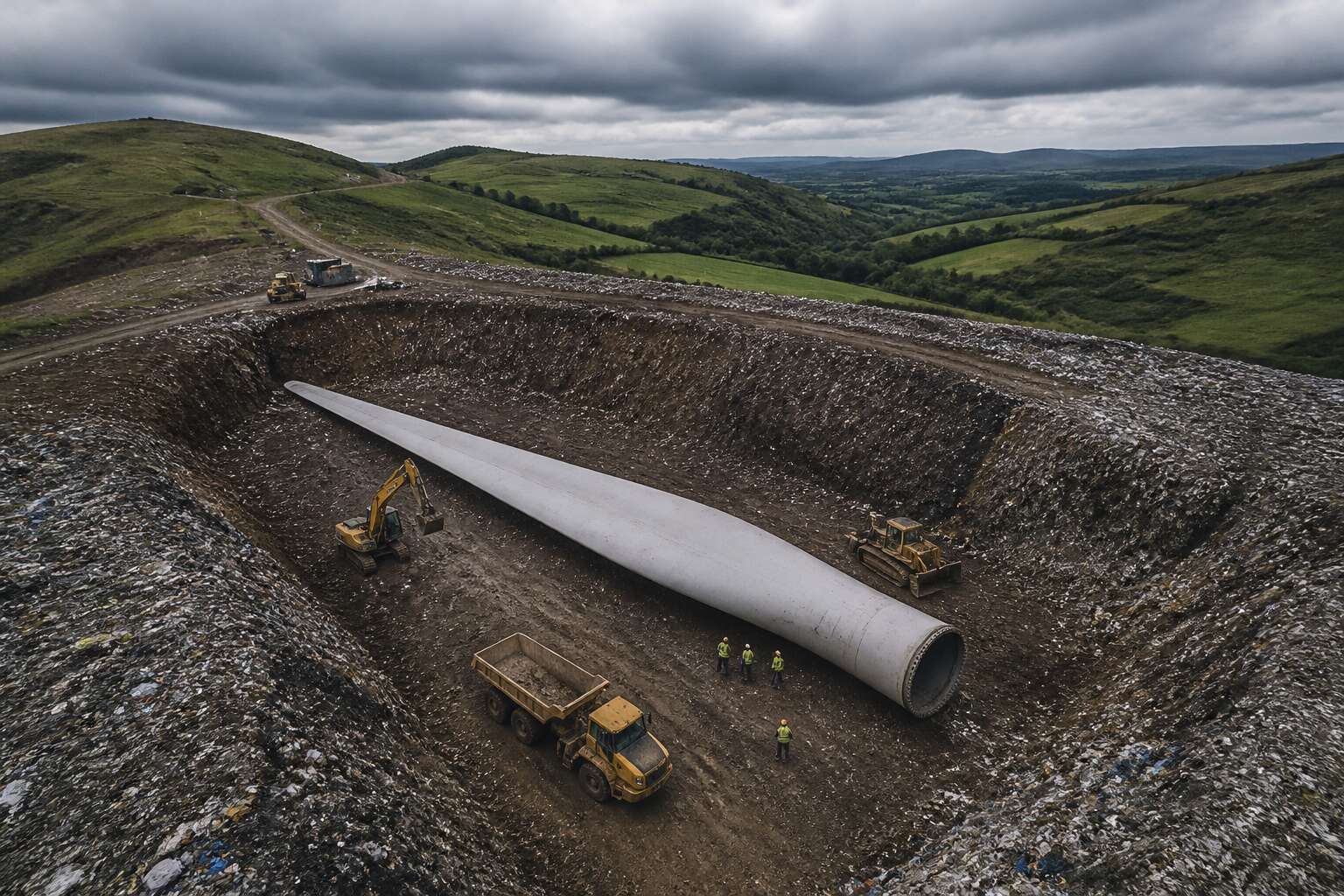
By 2050, the wind industry could face 43 million tonnes of spent blade material. These blades are massive, some stretching over 100 metres, and they are built from fibreglass and carbon fibre composites set in epoxy. That mix creates thermoset polymers, which permanently harden. Heating them does not liquefy them; it just makes them smoke. Shredding yields a dusty, low value filler. This is why the question of are wind turbine blades being buried is becoming urgent.
Blades also refuse to stay out of sight. They cannot be compacted easily. Their length and curvature exceed standard truck dimensions, so moving them costs a fortune.
Recycling approaches remain crude:
- Landfill burial: cheap but permanent
- Cement kiln co-processing: recovers energy only
- Mechanical grinding: yields weak filler
Each option has a drawback. I think the answer to “are wind turbine blades being buried” is often a reluctant yes.
The Growing Volume of Retired Blades
Every nine years, a blade comes down. Not worn out, but obsolete. The global fleet is young, yet the first wave of retirements has already begun. By 2030, Europe alone expects 4,000 blades to reach end of life annually. The question of are wind turbine blades being buried will define this decade.
The volume grows faster than our solutions. Consider the numbers:
- 43 million tonnes of blade material projected by 2050
- Blades longer than a cricket pitch, weighing 20 tonnes each
- Less than 3% of retired blades currently reach high value recycling
South Africa’s wind farms are young, but the pipeline is inevitable. Are wind turbine blades being buried here yet? Not on a large scale. The landfill space is finite, and we have not built the alternatives.
How Long Do Turbine Blades Actually Last
Are wind turbine blades being buried? That question moves from hypothetical to urgent when you measure the scale. A single blade from a modern turbine stretches over 100 metres, longer than the wingspan of a jumbo jet. It is a physical object that must go somewhere when retired.
Most blades are engineered for 20 to 25 years of service. The fibres and resins degrade slowly, but the turbine’s technology ages faster. A blade that still functions might lack the efficiency of newer designs, so operators swap it out early. In my conversations with maintenance crews, the average lifespan in practice runs shorter than the design life.
Consider what that means for South Africa:
- The first large wind farms were grid connected in the early 2010s
- Those blades approach the end of their first decade
- Replacement cycles will likely accelerate
So, are wind turbine blades being buried? The answer depends on whether we count only what arrives at landfill today or the volume already committed.
Where Do Decommissioned Blades End Up Today
Walk past any wind farm in the Karoo and you will see the blades turning, graceful and silent. Nobody thinks about where those blades will go when they retire. The scale is staggering! A modern turbine blade can weigh over 35 tonnes, and South Africa’s first utility scale turbines are already nearing the end of their working lives.
So where do decommissioned blades end up today? The honest answer is mostly in landfill sites, cut into transportable segments. The alternatives are few:
- Cement kilns for co-processing
- Storage yards while owners decide
- The occasional repurposing project
The cement kiln route remains the exception. I have yet to see a power purchase agreement that mentions blade disposal. Are wind turbine blades being buried? In the most literal sense, yes. Ask the landfill operators in the Eastern Cape who weigh each delivery in tonnes.
The Reality of Burying Wind Turbine Blades
What Happens in Landfills
Under a landfill’s outer layer, retired blades rest in excavated trenches, intact and stubborn. Operators crush each shell flat with excavator buckets, then cover them with clay and soil. Are wind turbine blades being buried securely enough to prevent future problems? From my experience on decommissioning sites, the answer is no!
Epoxy resin and fibreglass composite never decompose. They were built to survive cyclones and salt spray, and that resilience persists underground. Once interred, the blades behave in predictable ways.
- Blade fragments migrate upward as compressed waste settles beneath them.
- Rigid shells create voids that cause uneven ground and cracked capping layers.
- Hazardous leachate stays minimal, but the physical mass never breaks down.
The result is a buried structure that outlasts the landfill itself. That should trouble anyone who thinks disposal ends at ground level.
Municipal Solid Waste vs. Dedicated Blade Burial Sites
One 60 metre blade weighs about 15 metric tons. When municipal crews ask are wind turbine blades being buried safely, they rarely account for that weight against a landfill’s decomposing layers. The blade settles among food scraps, paper, and construction debris. Compacted waste beneath the blade sinks, but the rigid shell stays put, creating voids that destabilise the capping layer.
I have seen both models. Dedicated blade burial sites, known as monofills, separate the problem. Operators lay blades in neat rows and crush them consistently, reducing uneven settlement.
- Municipal cells carry mixed decomposition profiles, so blade fragments migrate unpredictably.
- Dedicated sites allow uniform compaction and predictable cap settlement.
- Neither site eliminates the reality that fibre glass and epoxy resin outlast the permit.
So are wind turbine blades being buried responsibly in either system? The buried structure remains a permanent physical intrusion, and South African engineers are only beginning to quantify the long term implications.
The Case of Casper, Wyoming’s Blade Graveyard
In Casper, Wyoming, the ground holds more than 1,000 retired turbine blades. They rest in a municipal landfill, sliced into transportable sections and stacked in the earth. This site has become a quiet reference point for anyone asking are wind turbine blades being buried in a way that will hold.
The blades arrived from across the United States, each carrying its own weight and chemical signature. Landfill operators compact them, cover them, and wait. What the Casper site reveals is unsettling:
- The blades do not decompose. They remain intact beneath the soil.
- The ground above them settles unevenly over the years.
- The monitoring obligations extend far beyond the landfill’s operating permit.
South African engineers study this graveyard closely. It is the closest thing we have to a preview of our own future.
Leachate and Environmental Concerns
The leachate from a buried blade is not rainwater. It is a slow chemical reaction that continues underground. Rain percolates through the compacted fibreglass and extracts residual resins and catalysts. This dark liquid collects beneath the fill, carrying substances that do not appear on a simple pH test. When we ask are wind turbine blades being buried with care, we must look at what they leave behind. Landfill liners work, until they tear. Monitoring wells sample this fluid. In South Africa, our high summer rainfall accelerates the process. The seepage includes:
– Phthalates from the composite matrix.
– Hardener residues that leach slowly.
– Fragmented glass microfibres that never dissolve.
These travel farther than expected, moving through clay and sand. They question the very definition of inert waste.
Why Blade Recycling Is So Challenging
Fiberglass and Carbon Fiber Composites
The very materials that make turbine blades light and strong are the reason recycling them is a headache. Fiberglass and carbon fiber composites are thermoset polymers, which cure into a rigid, insoluble mesh. Melting them down, as one might do with a plastic bottle, is impossible without destroying their structural integrity. Grinding them into powder requires enormous energy and yields a low-grade filler that manufacturers rarely want! I suspect this is why the question of are wind turbine blades being buried keeps appearing in boardroom discussions.
Because the composite material is so stubborn, recycling facilities often charge more than simply hauling blades away. The cost gap, combined with the sheer volume of decommissioned blades, makes burial the default option for most operators. Frankly, we are stuck with an engineering marvel that refuses to decompose gracefully.
The Thermoset Resin Problem
A single turbine blade is a massive block of thermoset resin. The curing process cross links polymer chains into a permanent three dimensional network. Once hardened, this network cannot be melted, dissolved, or reshaped. Heat only chars the surface.
This finality is what separates thermosets from thermoplastics. A bottle cap softens and flows again. A blade does not. Separating the glass fibers from the resin requires caustic chemicals or high temperature pyrolysis. Both methods are expensive and dangerous. No wonder operators look at the budget and ask are wind turbine blades being buried as the only viable outcome.
Shredding and Downcycling Limitations
Shredding a blade is a brutal process. Industrial machinery tears through fiberglass and resin in a matter of minutes. The output is a rough aggregate of glass fibers and polymer dust. This material has nowhere meaningful to go.
Most shredders deliver a product destined for downcycling:
- Cement kiln fuel, where the resin contributes heat and the fibers become ash.
- Construction filler for asphalt or concrete mixes.
- Low grade composite board for secondary uses.
The energy value is low, and the glass content damages processing equipment. The market value of this shredded output rarely covers transport and processing costs. So operators run the numbers, and I have seen the same math repeated across the industry. When shredding yields a product worth less than the process costs, the financial logic tilts toward disposal. That is why the question of are wind turbine blades being buried remains relevant across South Africa’s renewable energy sector.
Economic Barriers to Large-Scale Recycling
One hundred thousand tonnes of blade waste is expected annually by 2030, and South Africa’s share is already piling up. The price of hauling a single 60 meter blade to a processing facility can exceed the entire value of the materials inside it. That simple arithmetic decides the fate of most decommissioned units.
Large scale recycling requires consistent feedstock, dedicated machinery, and stable end markets. None of these exist at scale yet. The capital outlay for specialized cutting equipment is enormous, and the resulting glass fiber dust has almost no buyers. Without a revenue stream, the question of are wind turbine blades being buried becomes a balance sheet decision.
Consider the cost pressures:
- Transport costs rise with blade length.
- Processing fees stay high due to tool wear.
- Resale prices for recovered fiber remain near zero.
Alternatives to Burying Turbine Blades
Repurposing Blades as Infrastructure
Seeing a 45 meter blade reused as a footbridge in Ireland or as a bus shelter in Denmark redefines waste. These components possess remarkable compressive strength, which is why civil engineers now view them as prefabricated structural members.
Repurposing bypasses the energy hungry shredding process and the thermoset resin issue completely, because the blade never breaks down. When someone asks are wind turbine blades being buried, the answer depends on who owns the decommissioned asset. Some utilities still choose landfill because transport logistics are simpler.
- Pedestrian and cycling bridges
- Highway noise barriers
- Agricultural sheds and storage structures
- Public park furniture and playground elements
But a growing cohort of municipalities treats retired blades as free raw material. The challenge is certification, since building codes rarely anticipate a structure made from a wind turbine part. Still, the early pilot projects are proving that disposal is a choice, not an inevitability!
Cement Kiln Co-Processing
Inside the rotating maw of a cement kiln, the retired blade meets a fiercer fate than burial. Temperatures exceed 1,400 degrees Celsius. The thermoset resin that once defied decay becomes fuel. The glass fibers collapse into clinker, the mineral skeleton of cement itself. This process, co-processing, answers the question of are wind turbine blades being buried with a definitive refusal.
Cement manufacturers acquire an energy source and a feedstock. Blade owners avoid landfill fees. The environmental ledger still demands scrutiny, since emissions depend on kiln technology and blade composition.
Co-processing works best when blades arrive prepared:
– Shredded to consistent size
– Free of metal inserts
– Sorted to match kiln chemistry
The blade does not vanish. It transforms.
Pyrolysis and Chemical Recycling
Are wind turbine blades being buried? Pyrolysis says no. Inside an oxygen starved reactor, the blade’s resin vaporizes into oil and gas, while glass fibers emerge intact for reuse. Chemical recycling goes further. Solvolysis uses solvents under high pressure to dissolve the thermoset matrix, freeing both fiber and polymer for new products.
For South African operators, these technologies reduce waste without exporting problems. The economics depend on consistent feedstocks. Blades must be cleaned and sorted. Recovered materials are not virgin, but they hold value.
Pyrolysis yields three outputs:
- Pyrolysis oil
- Syngas for energy
- Recovered glass fiber
Chemical recycling offers purer fractions but uses more energy. Both beat burial.
Emerging Technologies for Blade Recovery
New recovery methods are shifting the answer to are wind turbine blades being buried. High voltage fragmentation sends rapid electrical pulses through the composite, cracking it along fiber boundaries. The recovered glass fibers keep more length and strength than shredded material. Supercritical fluid hydrolysis uses pressurized water above its critical point to dissolve the resin, yielding reusable chemical fractions.
These technologies carry high operating costs. They demand consistent blade supply and rigorous feedstock preparation. Metal fittings, paint layers, and core materials must be stripped beforehand. Output quality depends heavily on input consistency.
Emerging recovery processes include:
– High voltage fragmentation
– Supercritical fluid hydrolysis
– Flash Joule heating
Each process offers a practical alternative to burial. The systems work. The challenge is scaling them affordably.
Policy and Producer Responsibility
Policy is the sharpened tool that can finally reshape this industry. As governments confront the growing waste stream, legislation is beginning to answer how are wind turbine blades being buried. Several European nations now restrict composite disposal in landfills entirely. South Africa’s National Environmental Management: Waste Act similarly encourages circular economy principles, which pushes wind farm operators toward recovery over cheap disposal.
Producer responsibility schemes are gaining real traction. Manufacturers increasingly fund blade takeback programs or pay levies into national recycling pools. These mechanisms shift the financial burden away from ratepayers and landowners, placing it squarely on the companies profiting from turbine sales.
Policy mechanisms to watch include:
- Landfill bans on composite materials
- Mandatory recovery quotas tied to new installations
- Eco fees applied at the point of blade manufacture
Such rules make burial the expensive path, not the easy one. That forces innovation in recovery markets to mature with urgency.
The Future of Blade Disposal and Sustainable Solutions
Design for Recyclability
The question of are wind turbine blades being buried is increasingly a design problem, not a disposal one. Manufacturers are shifting from permanent thermosets to thermoplastic resins that soften under heat and can be reclaimed. This material change unlocks genuine circularity.
Design for recyclability also depends on soluble bonding layers, detachable spar caps, and structural adhesives that dissolve on command. A blade built this way can be dismantled into clean composite streams rather than a contaminated mass. Modular construction means damaged sections can be replaced without condemning the entire blade. This matters for South African wind farms, where transport logistics already favour segmented designs.
- Thermoplastic matrix systems with reversible curing cycles
- Mechanical interlocking root connections that eliminate glue joints
- Material passports identifying every constituent layer for recovery
These prototypes are already in field trials across Europe and Asia, and I have seen the early results up close. They are encouraging! As the technology matures, the burden of blade burial will shrink. Are wind turbine blades being buried today? Yes. Will they be buried in fifteen years? Current design choices suggest otherwise.
Industry Commitments and Circular Economy Goals
Industry commitments are reshaping the answer to are wind turbine blades being buried. Major manufacturers have signed pledges to make blades fully recyclable by 2030. Siemens Gamesa, Vestas, and GE have all published circular economy roadmaps with measurable milestones.
These goals include building a dedicated blade recycling market. No blade should enter a landfill by the middle of the next decade! South African operators are watching these timelines closely, and I have seen them adjust procurement contracts to allow for future take-back.
- Zero blade waste to landfill by 2040 across European markets
- Recycling rates above 90 percent for composite blade materials
- Mandatory take-back schemes attached to new turbine sales
Manufacturer timelines now include full recyclability targets for 2035. The answer will soon be obsolete as industry commitments treat blades as a resource stream rather than a liability.
The Role of Regulation in Ending Landfill Disposal
Landfill restrictions are intensifying worldwide. The question of are wind turbine blades being buried will soon be moot because environmental tribunals and waste licenses are rejecting composite disposal. In South Africa, I see the same pressure building on municipalities to align with European standards for trade.
Regulation now forces the future of blade disposal into a circular framework. Operators must provide a documented recovery path before a decommissioning permit is issued. Sustainable solutions are no longer optional when the law dictates results.
- Mandatory take-back clauses in all new turbine sales
- Standardized tracking of blade resin content
- Automatic penalties for any landfill deposit after 2026
This compliance architecture directly answers are wind turbine blades being buried by pricing it out of existence. The role of regulation is to make burial a financial liability, and the industry is pivoting rapidly toward recyclable design for this reason.
What This Means for the Renewable Energy Sector
The question of are wind turbine blades being buried is fading as the renewable energy sector reimagines the blade itself. Future blades will be born recyclable, with thermoplastic resins and modular designs that allow full material recovery. Manufacturers are already piloting these systems.
For South Africa, this transformation means local jobs in dismantling and reprocessing alongside assembly. The sector must build reverse logistics networks before the first large group of retirements arrives. Consider what this demands:
- Investment in domestic composite recycling plants
- Blade designs that separate fibres from resins in minutes
- Procurement contracts that reward circular end of life plans
Renewable energy can finally close its own production loop, and are wind turbine blades being buried will become a question for historians, not engineers.




0 Comments