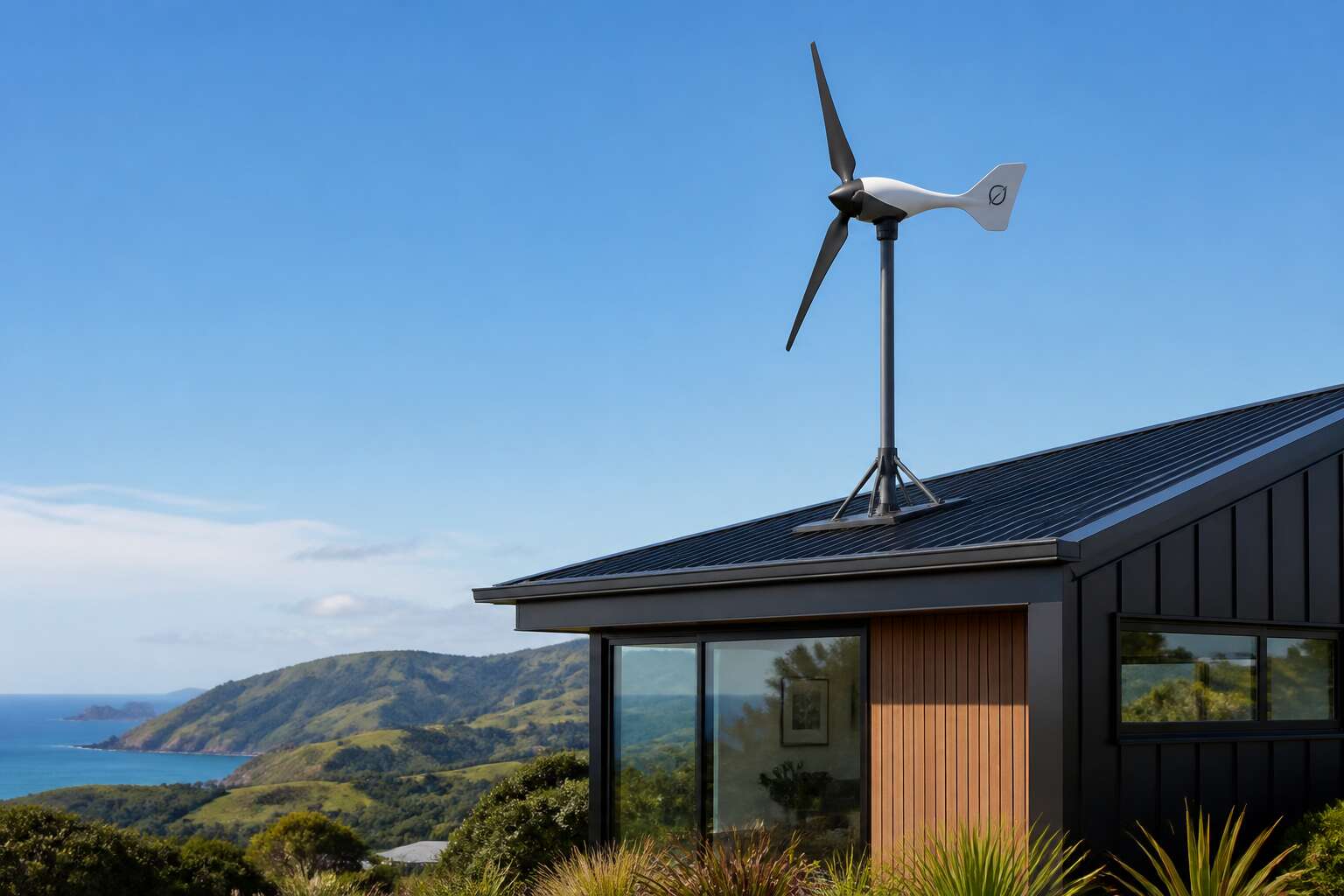
Understanding Rooftop Wind Energy in New Zealand
Benefits of On-Site Wind Generation for Kiwi Homeowners
New Zealand’s coastal winds reach average speeds of 7 m/s. For Kiwi homeowners, a small rooftop wind turbine nz captures this energy on site, cutting reliance on the grid.
On-site generation brings three clear advantages:
- Lower monthly electricity bills
- Energy independence during storms
- Reduced transmission losses
Installing such a turbine is not a universal fit, but for windy suburbs, the payback period keeps shortening. I have seen houses in Wellington generate enough to power their hot water systems entirely!
How New Zealand’s Wind Patterns Affect Rooftop Turbine Performance
New Zealand’s wind does not blow evenly. The Southern Alps force westerlies into narrow corridors, accelerating them through Cook Strait and across Wellington’s ridgelines. This terrain channelling can deliver average speeds above 8 m/s in some suburbs, yet those same corridors batter a poorly placed rotor with turbulence.
I have watched a small rooftop wind turbine nz spin furiously on a Wellington bluff, then sit idle three streets away where a roofline breaks the flow! Steady laminar air matters more than raw speed. Turbulence from trees or gables makes the rotor yaw constantly, wearing bearings and cutting efficiency.
- Coastal bluffs deliver strong but gusty winds
- Inland plains offer more consistent flow
- Urban canyons create swirling microclimates
Seasonal shifts complicate matters. Summer southerlies differ from winter northwesterlies, and a small rooftop wind turbine nz tuned for one season may underperform in the other. Knowing these local quirks prevents costly disappointment.
Local Council Rules and Consent Requirements for Residential Turbines
In New Zealand, the consent process for a small rooftop wind turbine nz often reveals more about human nature than engineering. Homeowners imagine a simple installation, only to face district plan rules that treat every blade as a potential grievance. The Resource Management Act grants councils wide discretion, meaning your neighbour’s view can outweigh your energy independence.
- Noise limits measured at the boundary
- Height restrictions from the roofline
- Vibration or shadow flicker concerns
Each council interprets these differently. A small rooftop wind turbine nz approved in Christchurch may face rejection in Dunedin. This uncertainty pushes some to skip consent entirely, which is a gamble. The psychological weight of paperwork often exceeds the physical installation. Patience, not wind speed, becomes the deciding factor.
Key Considerations Before Installing a Roof Turbine
Evaluating Your Roof’s Wind Resource and Exposure
When considering a small rooftop wind turbine NZ, assessing your roof’s wind resource is not guesswork. It demands honest data, not optimism! Many homes in built-up suburbs face turbulent, gusty conditions that throttle output.
From my experience, exposure matters more than roof height. A roof nestled among taller trees or neighbouring two storeys will see decelerated flow. Conversely, a house on an exposed ridge receives cleaner, more consistent winds.
- Check the prevailing wind direction using local weather records.
- Observe how nearby structures channel or block gusts over a few weeks.
- Measure roof slope and obstacles like chimneys or satellite dishes.
Your turbine can only perform as well as the air reaching it. Ignoring these factors leads to underperformance and wasted effort!
Noise, Vibration, and Aesthetic Impacts on Your Home
I have often wondered if homeowners truly prepare for the acoustic intimacy of a rooftop turbine. A small rooftop wind turbine nz generates more than electricity; it generates a rhythm. The blades slice air with a percussive pulse, while the gearbox emits a high pitched whine. Vibration seeps through roof structures, and that is what you feel in your bones at night.
Aesthetics also come to the fore. Your home’s architecture was designed for balance, and adding a metal armature changes its proportion. Neighbours will observe it before you do. Consider these impacts:
- Measure the existing roof’s resonance.
- Evaluate weatherproofing against long term vibration.
- Visualize the turbine from every street angle.
The roof now carries a new asset that demands your attention.
Structural Load Requirements for Roof-Mounted Turbines
I’ve seen too many homeowners skip the structural math. A small rooftop wind turbine nz adds forces your roof was never engineered to handle. The rotor torque alone can twist a mounting plate that isn’t properly tied into your rafters.
Structural Load Requirements for Roof-Mounted Turbines
Your mounting system transfers dynamic loads directly into the framing. Three forces demand attention:
- Dead load: the static weight of turbine, mast, and brackets
- Live load: wind gusts that multiply force several times over
- Fatigue load: cyclic stress that loosens connections over years
Your roof carries these simultaneously. A structural assessment must precede any installation. That’s non-negotiable!
Grid Connection and Net Metering Options
Grid connection is where most small wind projects stall. A small rooftop wind turbine nz must be approved by your local lines company before it can export a single watt. That approval process typically demands a certified inverter, a dedicated circuit, and sometimes a separate meter to isolate generation from household consumption.
Net metering options vary across New Zealand’s distributors. Some retailers credit exports at wholesale rates, others apply a lower buy-back tariff, and a few have introduced time-of-use pricing that shrinks the value of daytime generation.
- Your distributor’s embedded generation application process dictates the timeline
- Your existing meter must support bidirectional flow or be swapped out
- Retailer export tariffs differ enough to shift the payback period by years
Rooftop Wind Turbines vs. Solar Panels
Comparing Energy Output and Efficiency Across Seasons
In Wellington, July winds blow at nearly twice the speed of January’s gentle breezes. That seasonal swing changes everything. A small rooftop wind turbine nz can produce 40% of its annual energy during winter months, precisely when solar panels struggle with short days and low sun angles.
Solar panels peak from November to February, generating up to 70% of their yearly output. But in winter, their efficiency drops sharply. Wind turbines keep spinning through storms and overcast skies. The two technologies balance each other across the calendar.
- Winter: wind wins
- Summer: solar wins
- Spring and autumn: mixed results
For South African homeowners eyeing renewable options, pairing both systems reduces the seasonal troughs. The small rooftop wind turbine nz offers consistent output when sunshine fades.
Upfront Costs, Maintenance, and Payback Periods
The cost of going wind starts with a stubborn number. Solar panels for a typical Johannesburg home might land around R120,000, while a small rooftop wind turbine nz with its inverter and tower hardware can push past R180,000. That gap stings at first. But solar without battery storage goes silent at dusk. A turbine keeps drawing energy through the night, especially during our winter gales.
Maintenance separates the two further. Solar modules are static; they need a wipe down each quarter. Wind turbines spin, and spinning brings wear. Bearings, blades, and control electronics require annual inspections. Yet a properly installed small rooftop wind turbine nz from a reputable supplier runs reliably for twenty years or more.
- Solar payback span: 6 to 9 years
- Wind payback span: 8 to 12 years
Those payback periods shift with your tariff. Load shedding changes the calculus entirely. When Eskom cuts power, solar sits dead without batteries, but wind may still spin. Self consumption beats exporting during those hours, and the turbine often peaks in the evening when solar has already retired for the day.
Hybrid Wind-Solar Systems to Maximise Renewable Generation
Solar panels stop generating at sunset. A small rooftop wind turbine nz keeps spinning through the night. In South Africa, where evening winds are common, that combination cuts your reliance on Eskom more than either system alone. A hybrid setup uses the same inverter infrastructure, so the marginal cost of adding wind is lower than installing a separate system.
During winter storms, solar output drops while wind speeds rise. The two sources counterbalance each other across seasons and hours. For a typical Johannesburg home, pairing a 2 kW turbine with a 5 kW solar array can raise self-consumption to 80%. That means fewer units bought from the grid and better use of your own generation.
This is where the hybrid approach wins. The turbine charges batteries at night, and solar tops them up during the day. Combining solar with a small rooftop wind turbine nz gives you a steadier supply, fewer dips, and a system that works with South Africa’s weather patterns, not against them.
Selecting the Right Turbine for Your Property
Vertical-Axis vs. Horizontal-Axis Designs for Rooftop Use
Choosing the right small rooftop wind turbine nz starts with understanding the two main designs, vertical axis and horizontal axis. Each behaves differently on a roof in ways that matter for energy capture and structural stress. A vertical axis turbine catches wind from any direction, which suits turbulent urban airflow. A horizontal axis unit needs steady, directional wind to spin efficiently. For New Zealand rooftops, the tradeoffs can be subtle. Vertical axis models tend to sit closer to the roof, so they transfer less vibration but can struggle with gusts. Horizontal axis designs often sit higher, exposing them to cleaner wind but greater loads. Consider these factors when comparing options.
– Vertical axis: better for gusty, shifting winds; lower mounting profile; quieter operation.
– Horizontal axis: higher efficiency in steady wind; taller mast required; more maintenance access.
The mounting position influences both power production and the strain on your building frame. Your roof geometry will often point you toward one design over the other. Before committing to a small rooftop wind turbine nz, measure the wind direction and turbulence around your property. A professional assessment can reveal whether a vertical or horizontal axis system will perform best for your location.
Key Performance Specifications to Look For
Most rooftop turbine failures trace back to a mismatch between the stated specifications and the actual wind regime. A small rooftop wind turbine nz may advertise 400 watts at 11 m/s, yet your roof might see only 4 m/s. The cut-in speed matters more than the peak rating. Brands differ widely here. Some units start producing at 2.5 m/s, others stall until 4 m/s. That gap changes the payback equation entirely.
Annual energy output offers a truer comparison than peak power. Look for values derived from a standard Rayleigh distribution, not a single wind speed. Also scrutinise the survival wind speed. New Zealand storms can exceed 50 m/s on exposed ridges, so the turbine must withstand those loads without shedding blades. A flimsy hub assembly will fail long before the generator reaches its limit.
- Cut-in and rated wind speeds
- Survival wind speed rating
- Annual energy output at 5 m/s
- Generator efficiency and bearing type
Generator choice dictates how much maintenance you inherit. A coreless axial flux unit runs freely at low torque, while a cored generator stiffens under load, which stalls the rotor in turbulent air. Blade material also matters. Glass fibre handles UV exposure well, but nylon blades flex and absorb impact better. For a small rooftop wind turbine nz, match those characteristics to your specific roof height and surrounding tree lines before you purchase.
Reliable Brands and Real-World User Reviews
Selecting the right turbine begins with honest reflection on your actual wind resource. The best brand on paper fails if your roof sits in a turbulent lee. I have seen owners install a small rooftop wind turbine nz after a glossy brochure, only to find the cut-in speed never reached. Reliable brands share certain traits:
- publish real test data
- document field failures
- offer local support
Real-world user reviews reveal what specifications hide. Owners report some turbines hum at frequencies, or that bearing replacements occur sooner than promised. Look for patterns across forums and independent reviews, not isolated praise. A single bad review may be noise, but a recurring complaint about blade fatigue deserves attention.
The installation ecosystem matters. A robust small rooftop wind turbine nz still needs an electrician who understands inverters and a roofer who respects flashings. The human network around the machine matters as much as the machine.
Warranty, Support, and New Zealand-Based Service Providers
Warranty language reads like a legal labyrinth, and the fine print matters. A small rooftop wind turbine nz might carry a five year guarantee, but who actually honours it? Ask whether the manufacturer has a local agent. Ask whether the installer remains contactable next season. New Zealand based service providers offer a distinct advantage. They know the coastal corrosion, the gust patterns, and the council officers. They can inspect, repair, or replace components without shipping a unit across the Pacific.
Before you sign, ask these questions:
– Does the warranty cover labour or only parts?
– Are bearing and blade replacements included?
– Who pays for shipping and crane hire?
A distant warranty is a paperweight. A local support network turns the small rooftop wind turbine nz into a functioning asset rather than a decorative sculpture. Trust someone who answers the phone when the wind dies!
Installation and Maintenance Best Practices
Step-by-Step Process for Professional Installation
A rooftop turbine’s quiet hum can vanish overnight, leaving your home’s energy budget exposed. That silence often traces back to poor installation. For a small rooftop wind turbine nz, the difference between decades of service and a costly failure is determined in the first day on the roof.
Professional installers follow a strict sequence:
- Verify structural integrity of the mounting point.
- Mount the mast with vibration dampeners.
- Connect the electrical system with a separate ground.
- Run a calibrated test to confirm blade rotation.
Each step is documented. That record becomes your maintenance baseline.
Your own role in upkeep is simple: annual inspections of bolts, bearings, and blade edges. Corrosion from coastal salt air damages blades silently. A small rooftop wind turbine nz that gets a yearly check will outlast any neglected unit.
Choosing a Certified and Experienced Installer in New Zealand
There is no national licensing scheme for wind turbine installers in New Zealand, so your vetting process is the real safety net. A small rooftop wind turbine nz deserves an installer who shows you completed local projects.
When I interview candidates, I verify these points:
– They have installed on your roof type before
– They provide a written maintenance schedule for coastal exposure
– They share original torque and tension values for each bolted joint
You want torque settings, bearing grease specs, and inspection intervals documented. A good installer will also flag your specific corrosion risks. Coastal salt and high UV degrade blades quickly.
When your turbine returns for a service, the technician should record blade thickness and bolt tension every time. That record protects your investment and your roof. For a small rooftop wind turbine nz, installer experience with local wind regimes matters more than brand loyalty.
Routine Maintenance to Ensure Long-Term Performance
Installation practices determine how long a small rooftop wind turbine nz survives its first storm season. In my experience, the correct sequence involves mounting the bracket to roof joists, never just decking, then fitting vibration isolators between the mast and bracket. Cables should form a drip loop before entering the roof penetration, preventing water from tracking into the wiring.
Once commissioned, routine maintenance splits cleanly between the owner and a technician. Owners should record monthly energy output and note any sharp deviation. A drop of 15 percent, with unchanged wind speeds, signals blade fouling or bearing drag. Technicians then handle the deeper inspections. That split of responsibilities keeps the system under observation without overstating costs, and it protects the long-term performance of the turbine.
Troubleshooting Common Issues with Rooftop Generators
When a small rooftop wind turbine nz stops performing, the cause is often obvious but overlooked. Inverter faults account for most failures, not mechanical wear. The unit may spin freely but produce nothing, which points to rectifier or controller issues rather than wind availability.
Before suspecting the generator itself, work through the common failure points:
- Corroded or loose terminal connections
- Intermittent scraping from bearing wear
- Hairline cracks in the tower clamp after gust events
I have seen owners replace entire turbines over a single faulty crimp. Voltage irregularities at the battery or grid connection trace back to poor installation technique. The furling mechanism also gets neglected until it fails, leaving the mast exposed to uncontrolled forces. Troubleshooting becomes systematic once you accept that small rooftop wind turbine nz units fail through predictable patterns.
The Future of Micro Wind Generation in New Zealand
Emerging Turbine Technologies and Smart Controls
The future of small rooftop wind turbine nz installations is not raw power alone. It is intelligence. New designs use lattice frameworks and lighter composites, catching gusts that older blades would have ignored. These are not the clattering machines of the past. They are quiet, precise instruments, humming faintly above the roofline.
Smart controls are shifting the equation. Micro-inverters and predictive algorithms adjust blade pitch and orientation in real time, reading the erratic New Zealand winds that turn without warning. Some units now talk to home energy systems, deciding when to spin and when to rest, storing energy for the still hours.
- Adaptive pitch control for sudden squalls
- Remote diagnostics that flag wear before failure
- Battery pairing to smooth the erratic output
This convergence of hardware and software means a small rooftop wind turbine nz can operate almost unattended. We are moving toward a home that works without ceremony. The turbine becomes a quiet participant, expected to perform and easily forgotten.
Government Incentives, Rebates, and Feed-In Tariffs
The Kiwi government has not exactly rolled out a red carpet for micro wind. But there is movement. The Community Renewable Energy Fund and select regional councils offer partial grants for a small rooftop wind turbine nz installation. It is not a gold rush, but it helps.
- Check your local council’s resilience fund for distributed generation
- Ask your electricity retailer about excess generation credits
- Look into the GIDI fund for small-scale renewable projects
Feed-in tariffs in New Zealand are mostly a private affair. Retailers like Contact and Meridian offer buy-back rates, though they rarely inspire champagne. You get paid for surplus, not for the romance of it. Rebates remain scarce, so treat them as seasoning, not the meal.
Integrating Rooftop Turbines with Home Energy Management Systems
By 2030, a third of New Zealand homes could host distributed generation, yet few will have the brains to manage it. That is changing. The next phase for a small rooftop wind turbine nz is orchestration, not raw output. Home energy management systems now talk to turbines, batteries, and heat pumps in real time, shifting loads when the wind gusts and trimming draw when it lulls.
Micro wind becomes a responsive layer in the home grid, not a standalone gadget. A small rooftop wind turbine nz paired with a smart controller can charge an EV overnight or preheat water before a cold front hits. The HEMS decides, the turbine obeys.
- Forecast data triggers pre-heating cycles
- Surplus wind output routes to the hot water cylinder first
- Live export pricing decides whether to store or sell
Retailers are publishing dynamic price signals, turning variable generation into an asset rather than a nuisance. The future of micro wind is software that decides where those kilowatt-hours land!




0 Comments