Early Harnessing of Wind Power
Long before the modern turbine, people captured wind with sails and wooden blades. The earliest recorded windmills appeared in Persia around 900 CE, grinding grain and pumping water. These machines were not turbines in the modern sense, but they established the fundamental principle of converting wind into rotational energy.
This history matters when asking where was wind turbine invented. The answer depends on definition. Persia holds the claim for the first practical windmill. Scotland takes credit for the first electricity generating turbine in the late 1800s.
Early designs were simple but effective:
- Vertical axis windmills in Sistan used drag to turn a central shaft.
- Panemone mills, with their reed sails, powered small communities.
These efforts shaped every later breakthrough, yet they remain far removed from the towering turbines we see today.
The Transition to Wind-Powered Electricity
In 1887, a Scottish engineer named James Blyth powered his holiday home with a wind turbine. That moment marked a radical shift. For centuries, windmills had ground grain and pumped water. But this was different! This was electricity.
- Blyth’s turbine lit a lamp.
- In the US, Charles Brush built a larger machine.
- Danish scientists soon refined the design.
The transition to wind-powered electricity did not happen overnight. Early turbines were inefficient and expensive. Rural communities, especially in South Africa, saw the benefit of standalone power. I find it telling that to ask where was wind turbine invented is to trace a path from mechanical work to clean energy. The answer lies in those experimental sheds and backyards of the late 19th century.
Key Locations and Inventors in Wind Turbine History
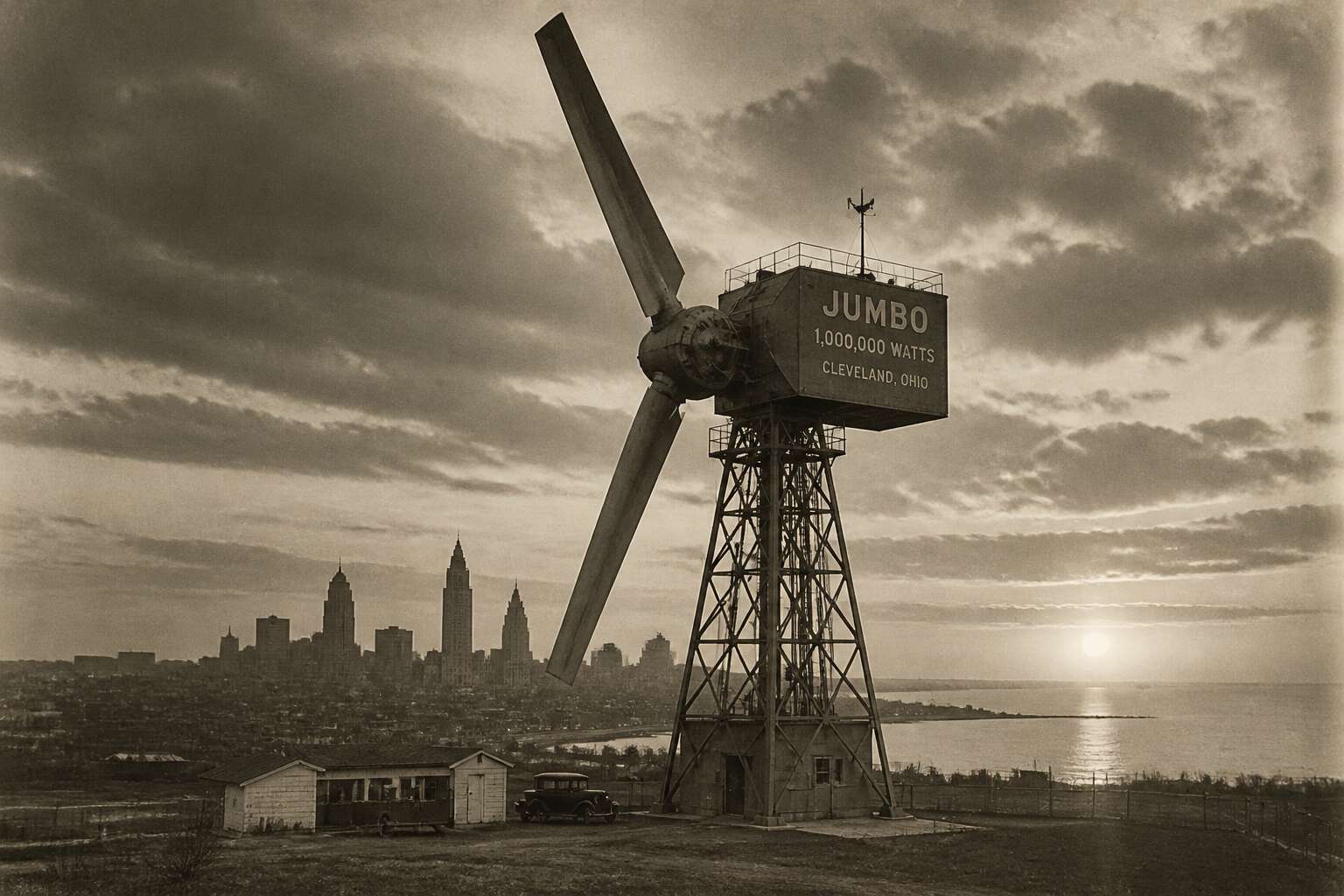
Cleveland, Ohio, holds the answer to where was wind turbine invented, though the story begins long before the first industrial dynamo. In December 1887, inventor Charles F. Brush constructed a massive backyard windmill to power his mansion’s lighting system. This was no delicate machine. It boasted a 17 metre rotor and a whopping 144 blades made of cedar wood. For my money, its sheer scale remains astonishing, especially considering it operated for twenty years without issue.
Brush’s creation generated 12 kW of power. It was a direct current system, standing as the first automatically operated wind turbine designed to generate electricity. Halfway across the world, a Scottish academic named James Blyth was conducting parallel experiments.
– Charles Brush, American entrepreneur, built the first self-contained turbine in his Ohio garden.
– James Blyth, a professor in Glasgow, lit his holiday home with a wind turbine in July 1887, months before Brush.
Blyth offered his surplus power to the local town, hoping to light the main street. The townspeople declined, calling electricity the work of the devil. A tragic refusal, really. Meanwhile, Brush’s grand machine became a spectacle, proving that the wind could feed the fledgling electric grid. Both men answered the question of where was wind turbine invented in their own way, separated by the Atlantic yet united by the same gale. Their visions, magnificent and slightly quixotic, seeded the turbines that now crown hillsides across South Africa.
The Global Expansion of Wind Power Technology
Ask where was wind turbine invented and the answer splits across centuries. Persia ground grain with reed blades around 900 CE. The Dutch later refined the post mill for drainage. Neither resembles the steel structures that now line South African ridges.
James Blyth changed everything in 1887. The Scottish professor lit a cottage using a wind-driven generator. That single act initiated a global pursuit.
Consider the milestones:
- Denmark connected a grid-scale turbine in 1976.
- California’s wind projects expanded rapidly in the 1980s.
- South Africa now operates more than 30 wind farms.
The expansion keeps moving. That first invention persists in every turbine that sends power to South African homes today.


0 Comments