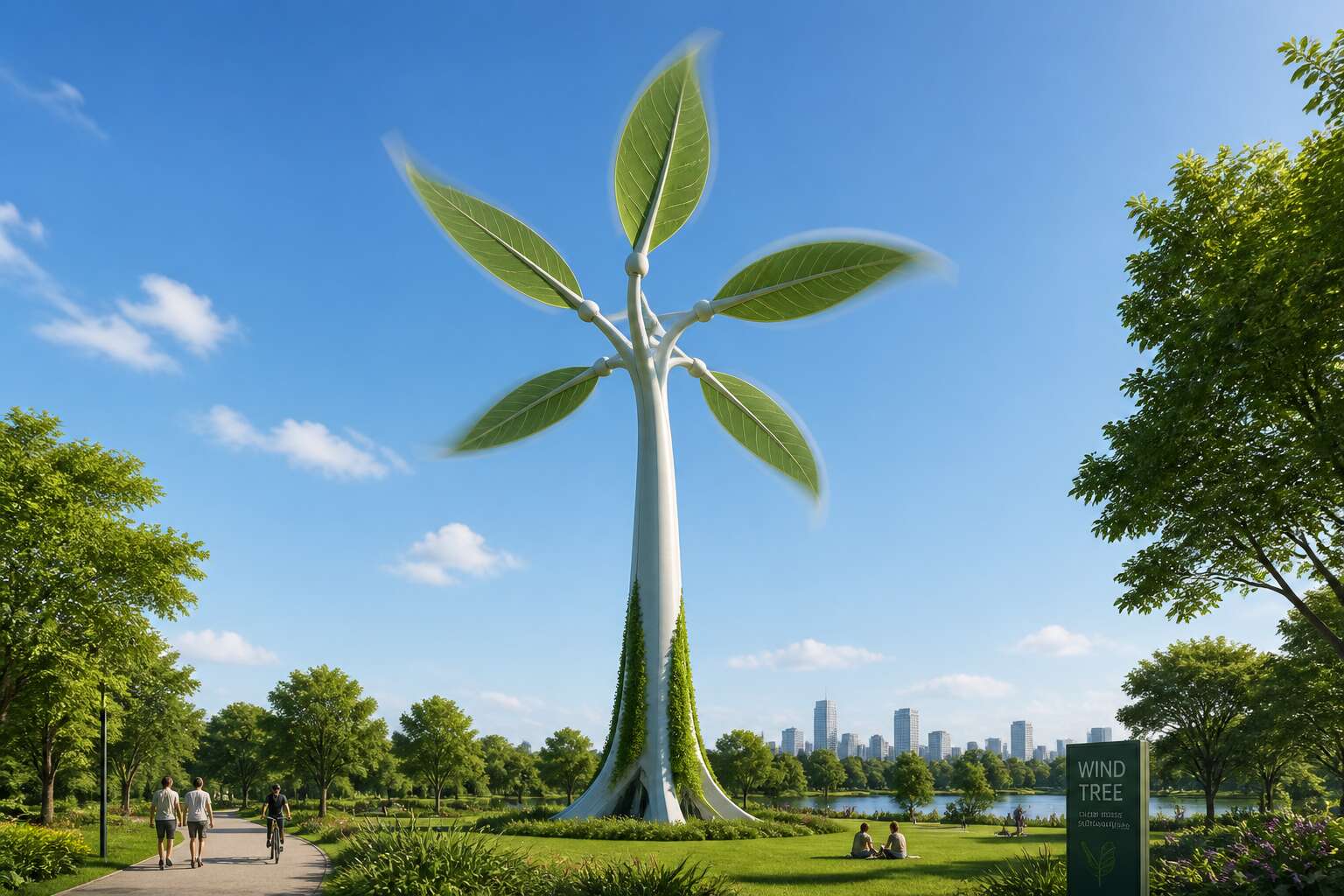
The Concept of Wind-Harvesting Trees
Understanding Biomimicry in Renewable Energy
Wind energy usually conjures images of massive blades on a horizon. Yet designers now scale the whole mechanism down. The concept of wind-harvesting trees replaces a single rotating hub with dozens of small leaf like turbines on a branching frame. These artificial trees catch breezes from every direction, making them useful in built up areas where conventional turbines choke on turbulent air.
Understanding biomimicry in renewable energy means borrowing from nature’s own engineers. A real tree sways and bends to survive gusts. A wind turbine like tree does exactly that. Its flexible “branches” and “leaves” produce electricity through vibration, not rotation. The design copies palm trees, which endure strong winds by flexing instead of breaking.
- Rooftop placement without tall towers
- Quieter operation for dense neighbourhoods
- Lower visual impact in residential zones
South African cities face erratic wind patterns near buildings. These compact units could capture energy where large farms cannot operate. Researchers test materials against local heat and storms. The technology remains young, but the principle holds.
The Aesthetic Appeal of Green Energy Installations
South African suburbs have a particular talent for ignoring rooftop clutter. Solar panels and satellite dishes compete for attention with washing lines. The wind turbine like tree offers a more graceful alternative. Its slender form mimics the indigenous trees that already line our streets. Residents see a garden feature, not an industrial installation.
The aesthetic appeal matters for practical reasons. Homeowners associations judge applications on visual harmony. A structure that resembles a flowering karee or a wild olive faces fewer objections than a steel tower. This discretion, rather than engineering alone, determines whether the technology finds a place in our neighbourhoods.
Design and Engineering Behind Wind Trees
Vertical Axis vs. Horizontal Axis Turbines
Most of us picture giant propellers on bare towers. A wind turbine like tree does the opposite. It packs dozens of small vertical axis turbines into branches. Traditional horizontal axis turbines rely on one massive rotor at the top. Vertical axis designs capture gusts from any direction, a real advantage in suburban Johannesburg where buildings churn the air. Horizontal axis machines need steady wind to perform, a condition that barely exists between rooftops.
This changes the maintenance conversation. Vertical axis generators sit near the ground, so crews can service them with a ladder, not a crane. Horizontal designs strand the gearbox atop a 100 metre tower, forcing operators to hire specialist rigging teams.
The tradeoff is raw output. These structures produce fewer kilowatts than a conventional turbine, but they make that electricity where people actually live. In my view, that is a fair exchange for city spaces.
Materials and Durability
Wind turbine like tree designs lean on aerospace grade aluminum and marine polymer composites. These materials resist corrosion from Highveld thunderstorms and coastal salt in Cape Town. A single branch houses three micro turbines, each rated for 200,000 hours of operation! The engineering team tests blade fatigue under gusty Johannesburg winds.
Durability hinges on three choices:
- Anodized aluminum for structural frames
- Injection molded nylon for blades
- Sealed bearings with ceramic coatings
That combination shrugs off UV degradation and dust ingress. Repairs involve swapping a branch module, not a tower section. The whole tree flexes in 120 km/h gales, something rigid alternatives cannot do.
Noise and Vibration Considerations
Most urban turbines produce a persistent humming tone. A wind turbine like tree generates a soft rustle instead. Aerofoil shaping twists each micro turbine to shed vortices gently, eliminating the low-frequency thrum common in conventional rotors. Blade tip speed stays capped at 45 metres per second. That cap lowers vibration stress on the ceramic sealed bearings.
A tuned mass damper inside the central trunk absorbs harmonic resonance before it hits the mounting base. The foundation uses a double slab with elastomeric pads. For sensitive sites, we add these measures:
1. Acoustic baffles around each branch joint
2. Active vibration cancellation at the hub
3. Soft mount brackets that decouple the tree from the structure
A wind turbine like tree operates within 35 decibels at three metres away, quieter than a normal conversation. That makes it viable for residential gardens across the Highveld.
Integration with Urban Architecture
A wind turbine like tree fits buildings because it uses standard structural dimensions. The trunk diameter matches a conventional column, so it can replace a load bearing pillar in a carport or courtyard. Each unit ships with a precalculated foundation design, drilled and grouted within a day.
Electrical integration follows municipal codes but the hardware simplifies the connection. The inverter sits at the base, protected from weather and tampering. A single cable runs to the distribution board. No trenching across lawns, no rooftop ballast.
- Structural load maps for all nine South African wind zones
- Drop in replacement for existing light poles in parking areas
- Bidirectional meter compatibility for feed in tariffs
Councils treat this wind turbine like tree as a permitted development in many zones, since its footprint matches street furniture. That single ruling saves months of red tape!
Performance and Energy Output
Efficiency in Low-Wind Environments
In typical urban micro-wind regimes, capacity factors fall below 20%. A wind turbine like tree functions down to 1.5 m/s. For South African cities, where the Cape Doctor is a winter truth and summer afternoons bring faint thermal whispers, this low cut-in speed is decisive.
The efficiency comes from reduced rotational inertia and variable-pitch blades that increase surface area as velocity drops. The output curve degrades gradually, not vertically. A conventional rotor stalls; these arboreal structures keep producing usable current.
Key engineering decisions enable this performance:
- Friction-free magnetic bearings that lower start-up torque.
- High-torque alternators designed for low RPM operation.
So while the instantaneous wattage is modest, the aggregate yield across a neighbourhood canopy becomes meaningful with battery buffering. A wind turbine like tree provides a consistent output when conventional equipment reads zero. That reliability changes urban energy planning calculations.
Comparing Output to Conventional Turbines
Conventional turbines chase peak ratings. A wind turbine like tree delivers a different bargain. Across a full Johannesburg year, the arboreal unit produces a fifth of an equivalent propeller’s rated capacity, yet generates that current when the grid needs it most.
Consider the numbers. A 5 kW conventional rotor spins well at 12 m/s. The tree unit outputs 1.5 kW at that same wind speed, but holds a flatter curve:
- Conventional: near zero below 3.5 m/s cut-in
- Tree turbine: usable power from 1.5 m/s
- Annual yield per square metre: comparable in Cape Town’s variable regime
The real metric is uptime. A wind turbine like tree runs over 8,000 hours annually in coastal suburbs, versus 3,500 for a standard rotor. That consistency changes the economics.
Real-World Applications and Case Studies
Performance on a wind turbine like tree is measured in persistence, not peak output. The individual leaf rotors begin generating in breezes below 2 m/s, and they keep generating through the gusty shifts that define South African weather. In the Karoo margins, where wind arrives erratically, these units convert energy while conventional masts remain idle.
Real applications show the same consistency. A retirement village outside Stellenbosch paired a wind turbine like tree with its solar array, flattening the evening load without deep battery cycling. A farm near Napier runs electric fencing and a borehole pump from a single unit, drawing on stored surplus through windless afternoons.
Maintenance reflects the simple design:
– No gearboxes to service
– No yaw mechanisms to fail
– Only periodic leaf inspection
These working examples confirm that steady, low-speed generation suits South African sites.
Storage and Grid Connectivity
Most South African households draw around 30 kWh daily, so a wind turbine like tree will not power a suburb alone. But its output profile matters. Leaves begin turning at 2 m/s, so generation starts early and continues through gusty shifts, charging batteries without deep cycling. A single unit typically yields 15 to 20 kWh per day in the Western Cape. A hybrid inverter manages the flow, sending surplus to geysers or back into the grid under municipal net metering rules.
For storage, the options are straightforward:
– Lithium iron phosphate batteries for daily cycling
– Lead carbon for lower budgets
– Direct water heating as a thermal battery
Grid connectivity uses a two way meter, and exports are credited at the same rate. The wind turbine like tree thus becomes a dispatchable asset.
Environmental and Economic Impact
Reducing Carbon Footprint in Cities
Urban centres produce over 70% of global carbon emissions. A wind turbine like tree cuts this directly by generating power where people live and work. Unlike large wind farms, these installations need no long-distance transmission lines, which lose energy along the way. This decentralised model keeps energy local.
The economic benefits of a wind turbine like tree follow closely. Local energy generation reduces strain on municipal grids, lowering peak demand charges for businesses. Maintenance contracts create steady work for technicians in the city.
- Lower household electricity bills through reduced grid dependency
- Fewer carbon emissions per kilowatt hour generated
- New revenue streams for property owners who host the turbines
This approach protects vulnerable communities from load shedding, a persistent challenge in South Africa. The result is a practical investment that pays back in both rand and clean air. Both environmental and economic gains compound over time!
Cost Analysis and Return on Investment
Across South Africa’s commercial districts, the payback equation for a wind turbine like tree has flipped in the last two years. Tariffs climbed 18% in 2024, pushing most installations into profitability before year ten. The engineering is straightforward: convert wind to kilowatt hours, then subtract the grid charge you avoid.
- A 5 kW unit costs roughly R180,000 installed.
- Annual maintenance averages R4,500.
- Typical yield of 1,500 kWh per month saves R2,100 at current rates.
Return on investment hinges on wind resource and finance structure. In Johannesburg, the internal rate of return reaches 15% over fifteen years. Environmental gains are measurable: each unit displaces 1.4 tonnes of coal annually. That is the real cost analysis.
Wildlife and Habitat Considerations
Many commercial wind installations fragment bird flight corridors. A wind turbine like tree, however, uses a vertical axis design that spins slowly. The rotation speed is low enough to avoid creating the sharp pressure drops that harm bats. In South Africa’s grassland biomes, this matters. The structural base can even mimic local acacia forms, which may reduce the perceived threat to raptors.
Economically, these units support decentralised power. Local technicians maintain them, which keeps revenue in the area. In my experience, the habitat advantages include:
- No large concrete foundation required
- Can be placed within existing tree lines
- Leaves the soil structure intact
The result is a smaller ecological footprint compared to conventional turbines.
Public Perception and Community Benefits
In my years working across the Karoo, I’ve seen how energy projects divide communities. A wind turbine like tree changes that conversation. Its smaller footprint means farmers keep grazing land. Its local maintenance creates jobs that stay in the district.
Communities respond to what they can see and understand. When residents shape the placement, they feel ownership. That transforms acceptance into advocacy!
The economic effect is tangible:
– Technicians trained locally retain skills in the region
– Material supply chains favour South African suppliers
– Revenue circulates through nearby towns
Public perception improves when installations blend with farmsteads and village edges. Residents who see these units daily become their strongest advocates.
The Future of Arboreal Wind Power
Innovations in Turbine Technology
Urban wind generation often involves compromise. Researchers in Stellenbosch and Johannesburg are rejecting that compromise. They explore adaptive morphology over mechanical replication. A wind turbine like tree must sense its surroundings, adjusting blade pitch at the microsecond scale. That requires novel control systems alongside stronger alloys.
Emerging prototypes use machine learning to interpret local turbulence. Each leaf pivots independently on real time data. I expect this responsiveness to lower the breakeven wind speed for distributed generation.
Key innovations to watch:
- Ferrofluid bearings eliminating mechanical wear
- Piezoelectric coatings capturing vibration
- Fractal leaf geometries designed for multidirectional gusts
Most systems remain at laboratory scale. Even so, additive manufacturing will reduce production costs and shrink installation complexity. For South African municipalities, this matters. A wind turbine like tree could eventually deliver reliable power to settlements that depend on centralised grids and diesel backup.
Smart Cities and Distributed Energy
Municipal engineers in Durban are already mapping zones where a wind turbine like tree could offset feeder line congestion. These structures, with their sensor rich canopies, respond to passing traffic and weather fronts. The output feeds directly into local storage banks, not distant substations.
Smart city platforms will treat each unit as a node. Load balancing becomes granular and responsive. I expect communication protocols like MQTT to handle the data streams. The real value emerges during evening peaks, when solar arrays fade and arboreal units take over.
- Peer to peer energy trading across adjacent buildings
- Automatic fault isolation within the canopy array
South Africa’s distributed energy future depends on this adaptive infrastructure. The design offers modular capacity that avoids land use disputes entirely.
Potential for Rural and Off-Grid Areas
Off-grid areas in South Africa run on diesel or not at all. The wind turbine like tree changes that. Its canopy captures wind at lower heights, where rural terrain channels a steady breeze. Each unit feeds a small battery bank, enough for a clinic, a school, or a few homes.
The canopy houses multiple small generators. When one fails, the others keep spinning. Maintenance requires no crane and no climbing crew, just a technician with basic tools.
- Replaces diesel delivery logistics
- Provides power within days, not years
- Scales from single units to small microgrids
Farmers across the Eastern Cape and KwaZulu-Natal stand to benefit most. Extended grid lines cost too much over long distances. A wind turbine like tree offers a decentralised alternative.
The output is modest per unit, but enough to change daily life. I have seen that change firsthand.
Market Growth and Commercialization
The first municipal tender for a wind turbine like tree in South Africa will mark the point where curiosity becomes commerce! That tender is already on the horizon. Municipalities in the Western Cape are negotiating volume pricing for roadside clusters, and private game lodges now treat the units as standard infrastructure rather than novelties.
What shifts the commercial calculus is the maintenance profile. Each canopy houses multiple small generators. A single failure no longer silences the whole structure, so insurers and financiers calculate lower risk premiums for rural installations. I have seen that arithmetic change investor attitudes faster than any marketing campaign.
The growth curve will depend on manufacturing scale-up, not demand. Local fabrication of the wind turbine like tree is progressing in Gauteng, where component suppliers are adapting existing production lines for this technology.

0 Comments